
Beyond Chord Tones: The Secret to Fluid II-V-I Lines on Jazz Guitar
Are You Trapped in the Chord-Tone Maze? If you're an intermediate jazz guitarist, you've undoubtedly encountered the "chord-tone" workout. You diligently practice the arpeggios for Cm7, Fm7, G7, and so on, memorizing their shapes across the neck. But what happens when you try to improvise? Your solos often sound disjointed, like you're desperately hunting for the root of each new chord. The melody feels choppy and lacks a sense of flow, as if you're awkwardly leaping from one isolated island (the chord) to the next. If this sounds familiar, it's time to embrace a crucial truth: memorizing chord tones alone will not make you a great improviser. The problem isn't the notes themselves, but the perspective from which you're viewing them.
For a complete map of how guide tones function across chord types, the Bridge Theory Reference page lays it out clearly.
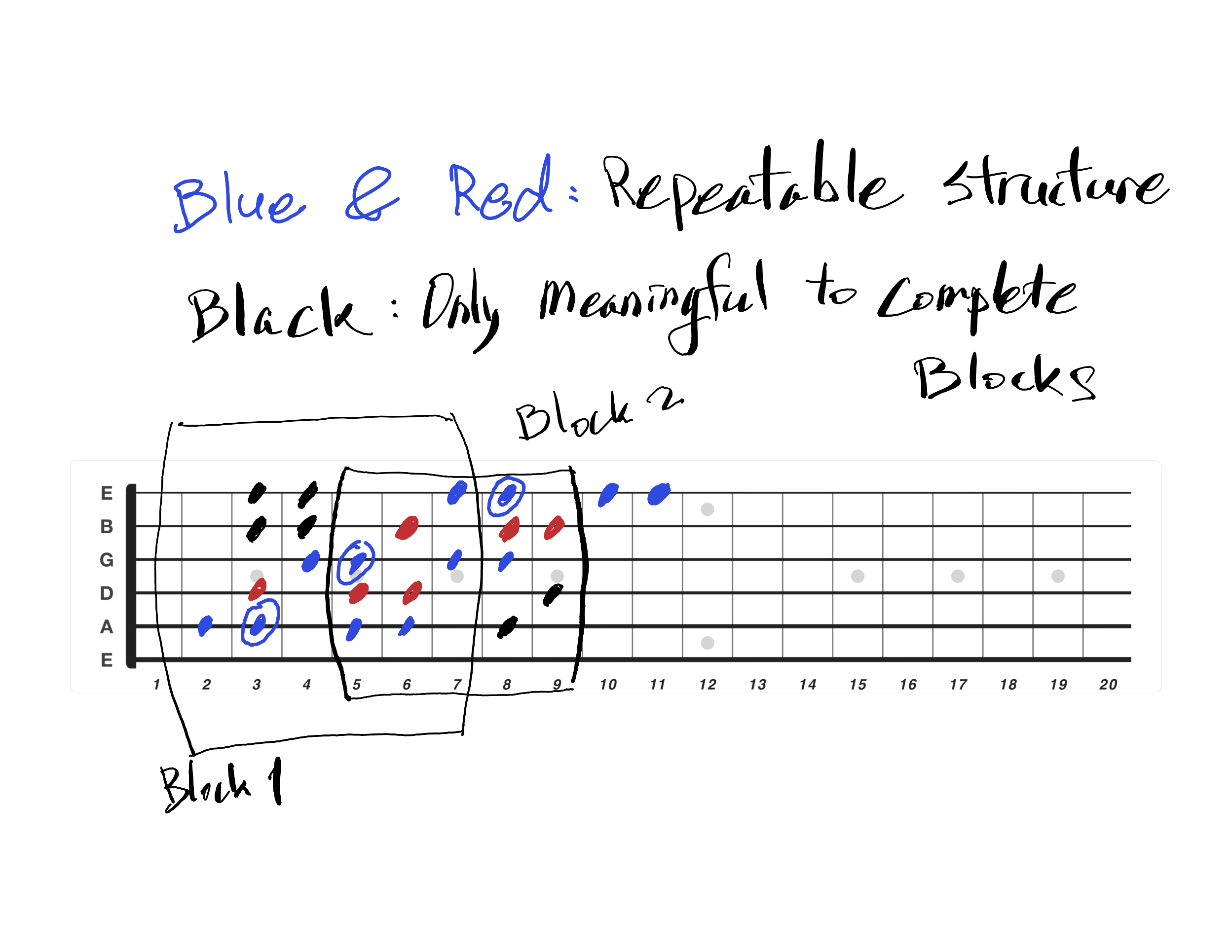
Confusing Block Scale vs Repeatable Structure
Focus on the 'Bridges,' Not the 'Islands'—Guide-Tone Voice Leading Unlike a piano or saxophone, the guitar is a structurally redundant instrument; the same note can be found in multiple locations. This unique characteristic makes it incredibly easy to get lost if you only think in terms of static "shapes" for each chord tone. The moment you pause to think, "Where was the root of Cm7 again?" the musical moment has passed you by. The solution lies in shifting your focus from the individual "islands" of chord tones to the "bridges" that connect them. This is the art of voice leading. Specifically, you must learn to track the movement of the 3rds and 7ths, also known as the guide tones. These two notes define the essential quality of a chord (major, minor, dominant), and they almost always move to the nearest possible note in the next chord, creating a smooth and logical melodic path. Let's examine this concept using the most common progression in jazz, the II-V-I, for example, in C minor: Dm7b5 – G7 – Cm. 1. For Dm7b5 (the II chord): The guide tones are its 3rd (F) and b7th (C). 2. For G7 (the V chord): The guide tones are its 3rd (B) and b7th (F). 3. For Cm (the I chord): The key chord tones are the b3rd (Eb) and b7th (Bb). Now, let's trace the movement of these guide tones: • The 'C' in Dm7b5 moves down by a half step to become the 'B' in G7. • The 'F' in Dm7b5 is held over to become the 'F' in G7. • The 'F' in G7 resolves down by a whole step to become the 'Eb' in Cm. • The 'B' in G7 resolves smoothly to either the 'Bb' or the root 'C' of the Cm chord. As you can see, while the roots of the chords are making large leaps (a 4th up/5th down: D → G → C), the guide tones are shifting subtly and efficiently within a very small melodic range. When you build your improvised lines around this smooth guide-tone motion, your soloing transforms. It is no longer a fragmented series of arpeggios chasing after roots, but a lyrical melody that gracefully rides the wave of the harmony. This is the very essence of a functional, diagonal approach to the fretboard. You start to see the connections, the lines of tension and release, that exist between the chords.
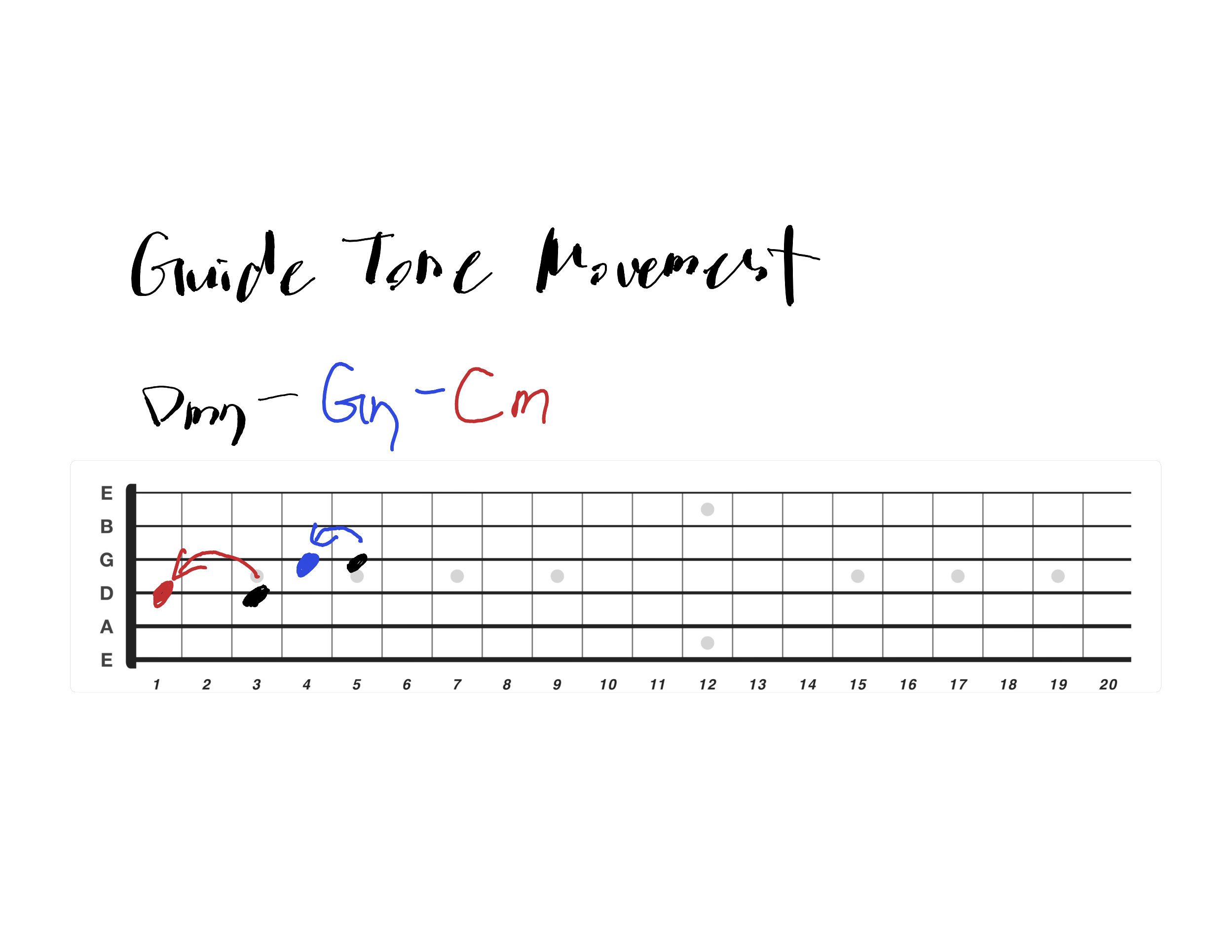
Clear Guide Tone Voice Leading
See the Fretboard as a Flow of Functions Starting today, I challenge you to shift the paradigm of your practice. Instead of spending hours memorizing chord-tone shapes, take a tune you're working on and find its II-V-I progressions. Then, focus solely on tracing the path of the 3rds and 7ths from one chord to the next. You will be amazed at how effectively just two notes can outline the entire harmonic movement. When you begin to see the fretboard not as a collection of isolated blocks, but as a vast, interconnected map of harmonic functions, your jazz guitar solos will finally begin to sing.
For a deeper dive into voice leading and functional harmony, visit Bridge: Theory and Sound for full lessons and more.