
Master Jazz Guitar Scales: The Beginner's Guide to the 'Diagonal Form’
Introduction: Stop Memorizing Endless Scale Blocks! When you first start playing jazz guitar, the sheer number of scale forms and positions can be overwhelming. You're told to memorize one block for this position, another for that one, and soon enough, the fretboard feels like a confusing patchwork quilt. This piece-by-piece memorization often distances us from the actual goal: making music. But what if there was a way to navigate the entire fretboard using one intuitive principle, freeing you from rote learning? Today, for those taking their first steps into jazz guitar improvisation, we'll introduce the "Diagonal Form" approach—a method that allows you to move freely across the neck without having to memorize a dozen different shapes.
The full framework behind this is the Functional Diagonal Approach.
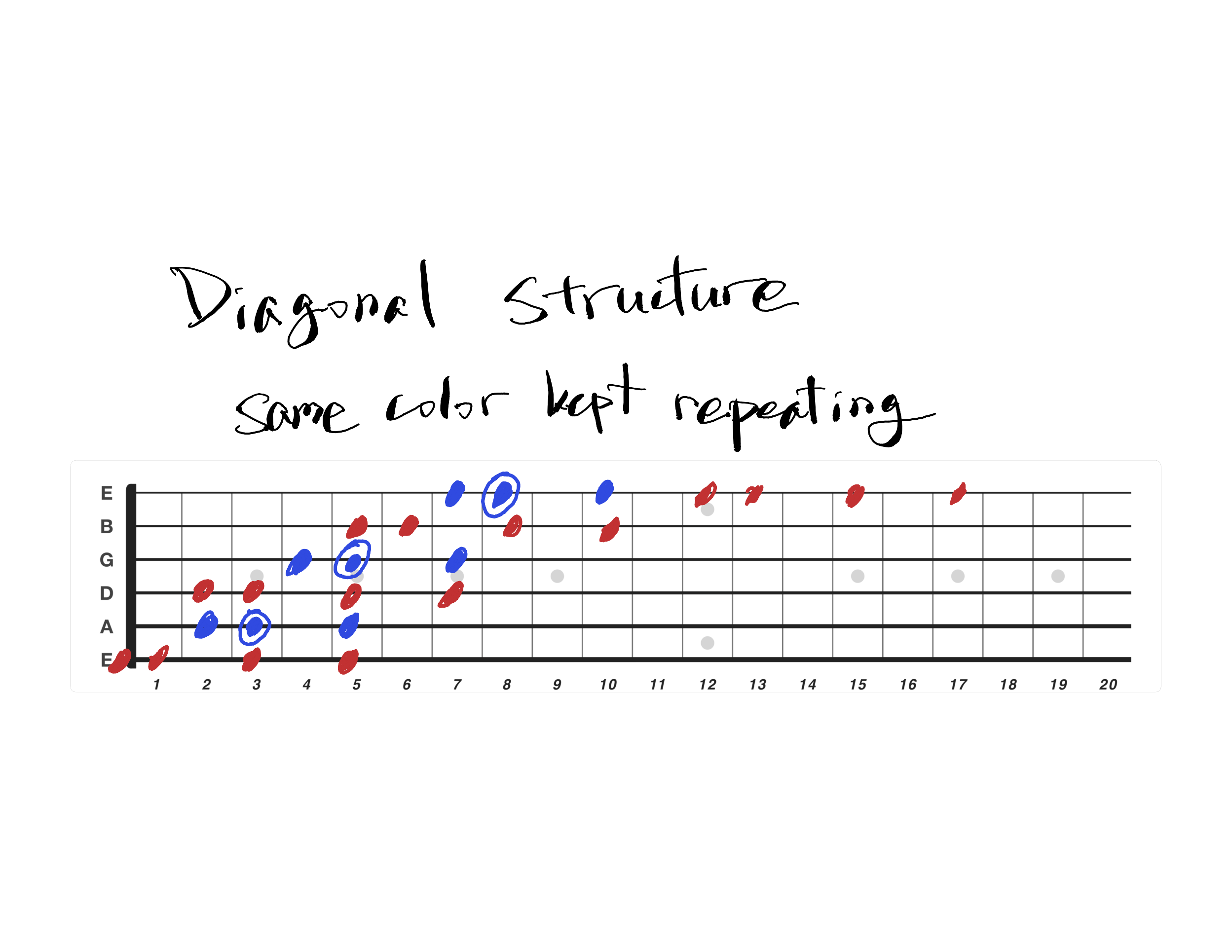
Same repeatable structure on the guitar fretboard
'Skip a String, Same Shape' The core principle of the diagonal scale method is surprisingly simple: "The fingering pattern repeats when you skip a string." For example, the major scale form you use starting on the 5th string is the exact same shape you'll use on the 3rd string and the 1st string. Likewise, a form that starts on the 6th string can be reapplied identically on the 4th and 2nd strings. Let's use the C Major scale as our primary example. We'll start on the 'C' note at the 3rd fret of the 5th string. The typical way to ascend from here would involve a continuous, multi-string pattern. In the diagonal approach, we think in smaller, repeatable cells. • On the 5th String: We play the first few notes of the scale (e.g., C, D, E). • Moving to the 4th String: We continue the scale (e.g., F, G, A). • Moving to the 3rd String: We find our C major scale notes here (e.g., B, C, D). Here's the magic: the fingering pattern used to play the notes on the 5th string is the exact same as the pattern used on the 3rd string, just starting on a different note of the scale. When you combine these two identical shapes, you create a logical, diagonal path up the fretboard. Suddenly, you're not confined to a single, static "box." You are seeing a fluid pathway that connects different areas of the neck. This method transforms the fretboard from a collection of isolated blocks into an interconnected map. This is precisely the kind of efficient thinking used by advanced players and is even a core concept taught at institutions like Berklee College of Music to master all scales and modes with a minimal number of forms. By understanding this principle, you stop seeing the fretboard as a grid to be memorized and start seeing it as a landscape to be explored. The horizontal and vertical connections become clear, and improvisation feels less like recalling data and more like a natural journey.
If you want to go further with the diagonal system and really map it across the fretboard, Fundamental 1: Wes Diagonal System gives you the complete framework.
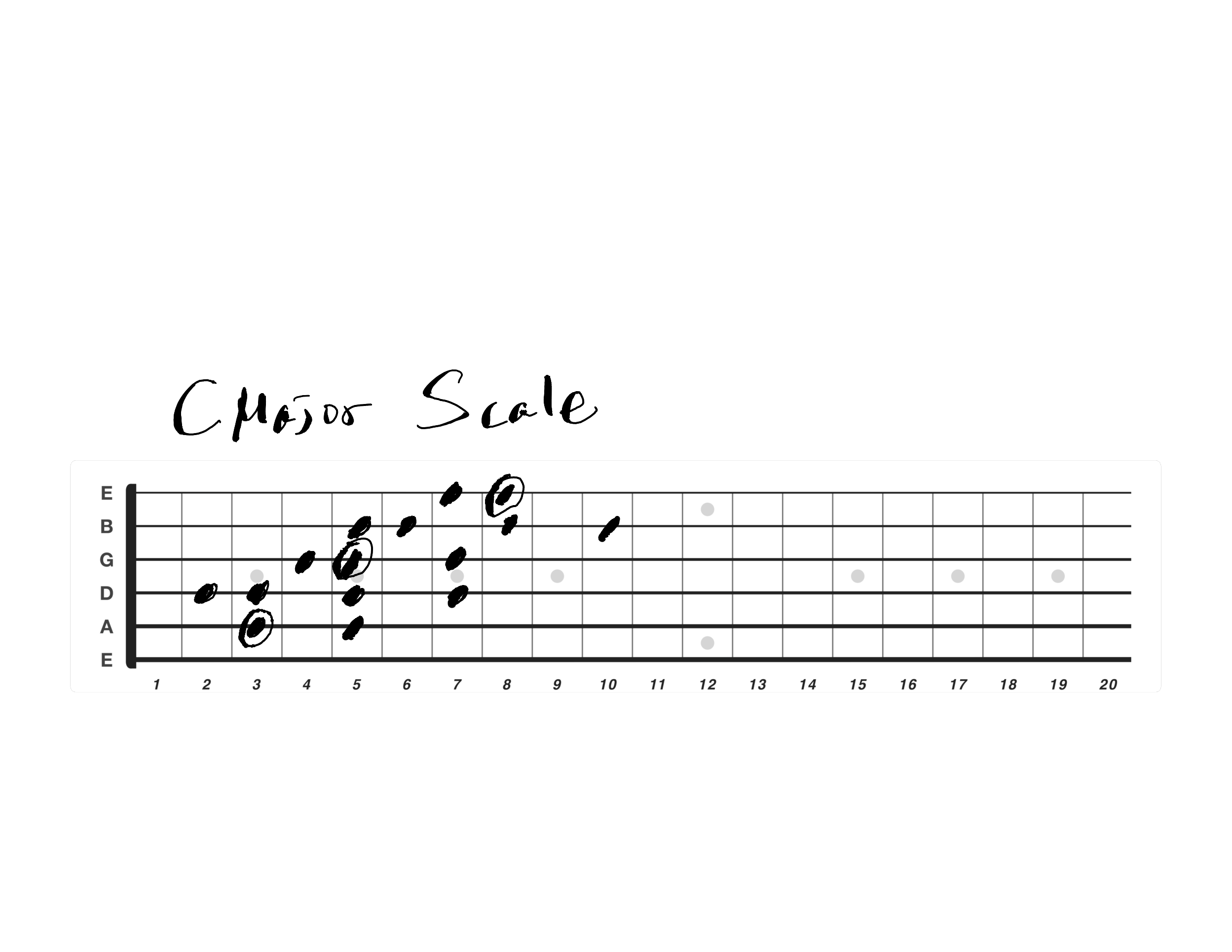
C Major Scale in repeatable structure
Your Goal for This Week—Master One Diagonal Form Today, you've learned a new perspective on practicing jazz guitar scales. Instead of getting bogged down in memorizing countless blocks, remember the simple diagonal principle: "skip a string, same shape." For this week, set aside all other scales and focus on just one thing: the C Major diagonal form. Spend quality time moving between the 5th and 3rd strings, allowing your fingers to internalize the path. Once this single pathway becomes second nature, you'll be amazed at how easily you can apply the same logic to other scales (minor, modal, etc.). This is your first major step toward seeing the fretboard with freedom and confidence.
To explore a more comprehensive curriculum on this concept, visit Bridge: Theory and Sound on Major Scale for lessons and more insights.