

Why Do Your Comping Chords Sound Empty Compared to Your Solo Lines?
A bare triad sounds full and confident in a solo line, but hollow the moment you use it to comp behind yourself. The missing ingredient is the guide tones — the 3rd and 7th that actually tell your ear which chord you're on.

Guitar? Three Upper Structures Over One ii-V-IWhat Is Superimposition on Jazz
Over Cm7–F7–Bbmaj7 the band plays those chords and you play Ebmaj7, F# minor and Gm. That is superimposition: your harmony sits on top of theirs, and the melody decides which tensions are allowed.

Is Jazz Theory Only for Jazz? I Transcribed a Pop Ballad and Found All of It
Every composer already uses voice leading — they just don't call it that. Transcribing a pop ballad revealed the same 3rd-targeting melody and passing 7ths that jazz musicians spend years learning. The theory isn't a jazz dialect; it's the grammar underneath.

How Do You Solo Over There Will Never Be Another You? Watch the Seesaw
There Will Never Be Another You balances melody and harmony like a seesaw: when the chords move, the melody rests; when a chord sits still, the melody gets busy. Read that balance and the framework solo builds itself on 3rd targets.

What Is a ii-V-I, Really? It’s How Songs Learned to End
The ii-V-I is a cadence — the classical art of ending a piece — with one extra link of circle-of-fifths bass motion bolted on. Understand it as an ending and every ii-V in the middle of a tune suddenly makes sense.

How Do You Build a Jazz Solo? Start With a Framework Line, Not a Scale
A jazz solo isn't a scale poured over chords — it's built in layers. Start with a framework line of guide tones, then add upper structures, Wes and Django lines, and approach notes.

Which Notes Matter Most for Voice Leading? The Melody Already Told You — It’s the 3rd
The most important voice-leading note over each chord is almost always the 3rd — and in most standards the melody is already sitting on it. Fly Me to the Moon, All The Things You Are, and Autumn Leaves prove it chord after chord.

Jazz Guitar Voice Leading: Soloing Through I’ll Be Seeing You With Guide Tones and the Wes Line
To solo with voice leading on I'll Be Seeing You, treat the Ebmaj7 as a Cm6, choose your fretboard position with the Wes Line, and move guide tones smoothly between chords. The first eight bars and second eight share the same voice-leading shape.

Voice Leading Guitar: Why a Chord Changes When Only One Note Moves
A chord doesn't change because every note changes — it changes when a single note moves. That one idea, practiced through triad cycles and circle-of-fifths shell voicings, is the heart of voice leading on guitar.

Jazz Guitar Upper Structures: How Shell Voicings Become Rootless Upper-Structure Voicings
Upper structures aren't a separate subject — they grow out of shell voicings. Drop the root from a 1-3-7 shell, raise the guide tones into tensions, and you're already playing upper-structure, rootless voicings.
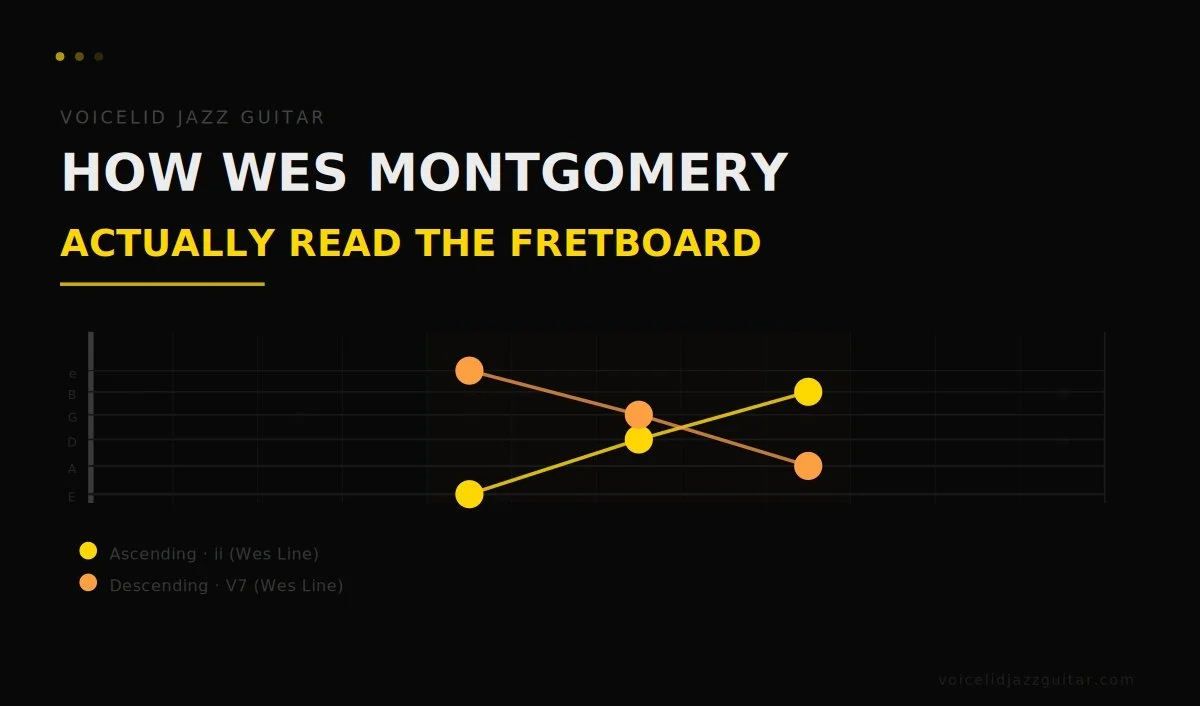
How Wes Montgomery Actually Read the Fretboard
Most players trying to learn from Wes Montgomery start with the octaves. That's the imitation. This is what was actually happening underneath.

How to Practice Triads for Voice Leading
Think you know triads? The 'Mick Goodrick' cycle approach changes everything. Learn how moving one note creates functional harmony.
Breaking Through Your Improvisation Rut: A Practical Guide to Connecting Melody and Guide Tones
You know your scales and chord tones—but your improvisation still doesn’t sound musical.
The missing link isn’t more theory. It’s learning how to connect melody and harmony through guide tones, voice leading, and simple triadic movement inside a real song.
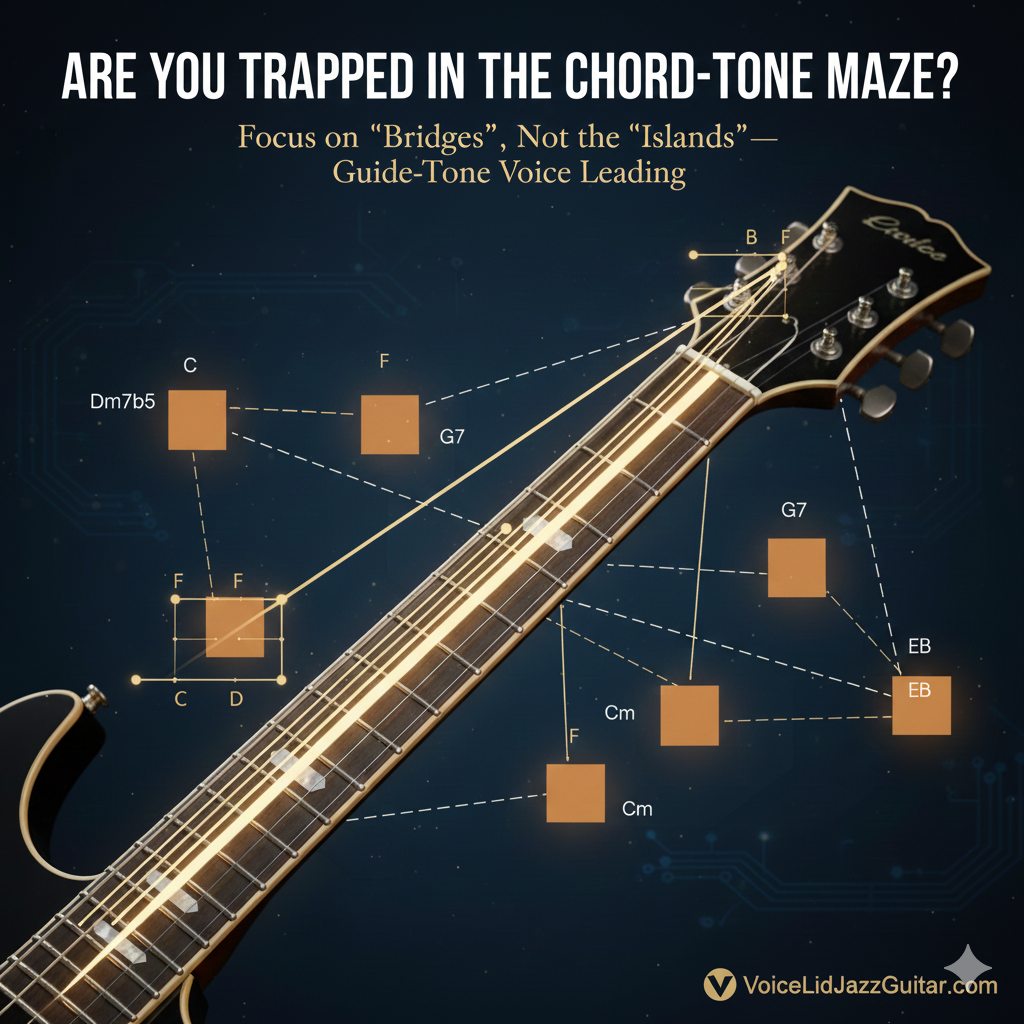
Beyond Chord Tones: The Secret to Fluid II-V-I Lines on Jazz Guitar
Most players memorize chord-tone shapes but still sound disconnected. This article explains why guide-tone voice leading—not arpeggio recall—is the key to flowing II–V–I improvisation, and how tracking 3rds and 7ths creates smooth, lyrical lines.

How to Start Self-Taught Jazz Guitar: A 3-Step Method to Master Your First 'Real Book' Tune
Feeling lost when opening the Real Book? Many guitarists jump straight into chords or melodies without truly understanding the tune’s structure. This three-step approach—focusing on melody, bass, and shell voicings—shows how to internalize any jazz standard from the inside out.