
Breaking Through Your Improvisation Rut: A Practical Guide to Connecting Melody and Guide Tones
You know your scales and chord tones—but your improvisation still doesn’t sound musical.
The missing link isn’t more theory. It’s learning how to connect melody and harmony through guide tones, voice leading, and simple triadic movement inside a real song.

Deconstructing Harmony: A Functional Analysis of 'Blue Bossa' with Upper-Structure Triads
Upper-structure triads let you create rich, modern sounds over simple chords. By reinterpreting Cm7–Fm7 or Dm7b5–G7–Cm through superstructures, the fretboard becomes a logical map of colors, not isolated shapes. This post breaks down Blue Bossa using real functional UST flow.
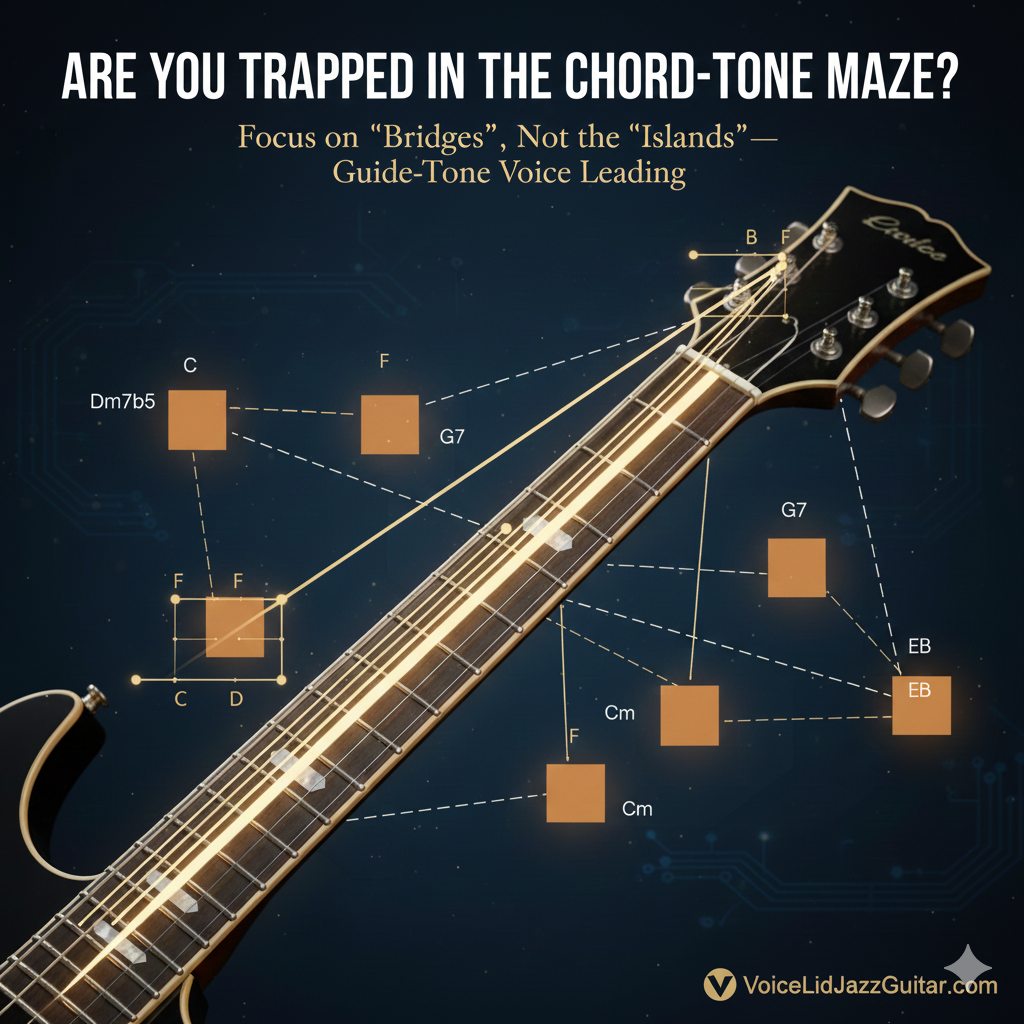
Beyond Chord Tones: The Secret to Fluid II-V-I Lines on Jazz Guitar
Most players memorize chord-tone shapes but still sound disconnected. This article explains why guide-tone voice leading—not arpeggio recall—is the key to flowing II–V–I improvisation, and how tracking 3rds and 7ths creates smooth, lyrical lines.

Liberating the Fretboard: Wes Montgomery's Diagonal Logic and Functional Harmony
Many players feel trapped in vertical scale positions. This article explains how Wes Montgomery’s diagonal fretboard approach, harmonic function, and upper-structure triads reveal the guitar as a flowing map of color and tension—not a set of boxes.
Is Memorizing Chord Tones Enough for Jazz Guitar? (A Better Approach for Beginners)
Many guitarists memorize chord tones but still struggle to sound musical. This post explains why chord-tone soloing often feels mechanical and shows how shifting to a pianist’s mindset—melody + harmony together—instantly transforms your improvisation.