
Decoding the "Wes Line": Upper Structures in Fly Me to the Moon
Why Basic Chord Tones Sound Boring
Beginners are often told to practice chord tone arpeggios. So, over an Fm7 chord, they play F-Ab-C-Eb. While theoretically correct, this approach often sounds mechanical and lacks the floating, sophisticated quality found in pro-level playing. The secret isn't just playing chord tones; it’s playing the Upper Structure Chord Tones. As discussed in my lecture, improvisation becomes truly interesting when we move away from the root and explore the extensions (9th, 11th, 13th) by superimposing triads or seventh chords from the 3rd or 5th of the underlying harmony. Let’s break this down using standard changes from Fly Me to the Moon in the key of Ab.
The "Wes Line" Concept
Let’s look at the first few bars: Fm7 - Bbm7 - Eb7 - Abmaj7. Instead of playing the literal chord arpeggios, apply the Upper Structure logic:
1. Fm7 becomes Abmaj7: If you stack thirds starting from the 3rd of Fm7 (Ab), you get an Ab Major 7 chord. When you play an Abmaj7 arpeggio over an Fm7 bass note, you are sounding the 3rd, 5th, 7th, and 9th of the minor chord. This conversion of Minor 7 to Major 7 is what I call the "Wes Line," a technique heavily utilized by Wes Montgomery.
2. Bbm7 becomes Dbmaj7: The same logic applies. The upper structure of the ii chord (Bbm7) is the IV chord (Dbmaj7).
3. Eb7 becomes Dbmaj7(b5): Over the dominant, we can maintain smooth voice leading. The shape is incredibly close to the previous chord, requiring only a slight modification.
If you want to go deeper on Wes Montgomery’s approach, Wes’ Insight breaks down the exact fretboard logic behind this sound.
The Benefit: Economy of Motion
The beauty of this approach lies in its efficiency on the fretboard. Root motion often forces you to jump around (intervals of 4ths and 5ths). Upper structures, however, often sit right next to each other physically. You can navigate through an entire 8-bar progression staying in one position, connecting chords through subtle shifts rather than leaps. This creates a "singing" quality to your lines, where harmonies morph into one another rather than start and stop.
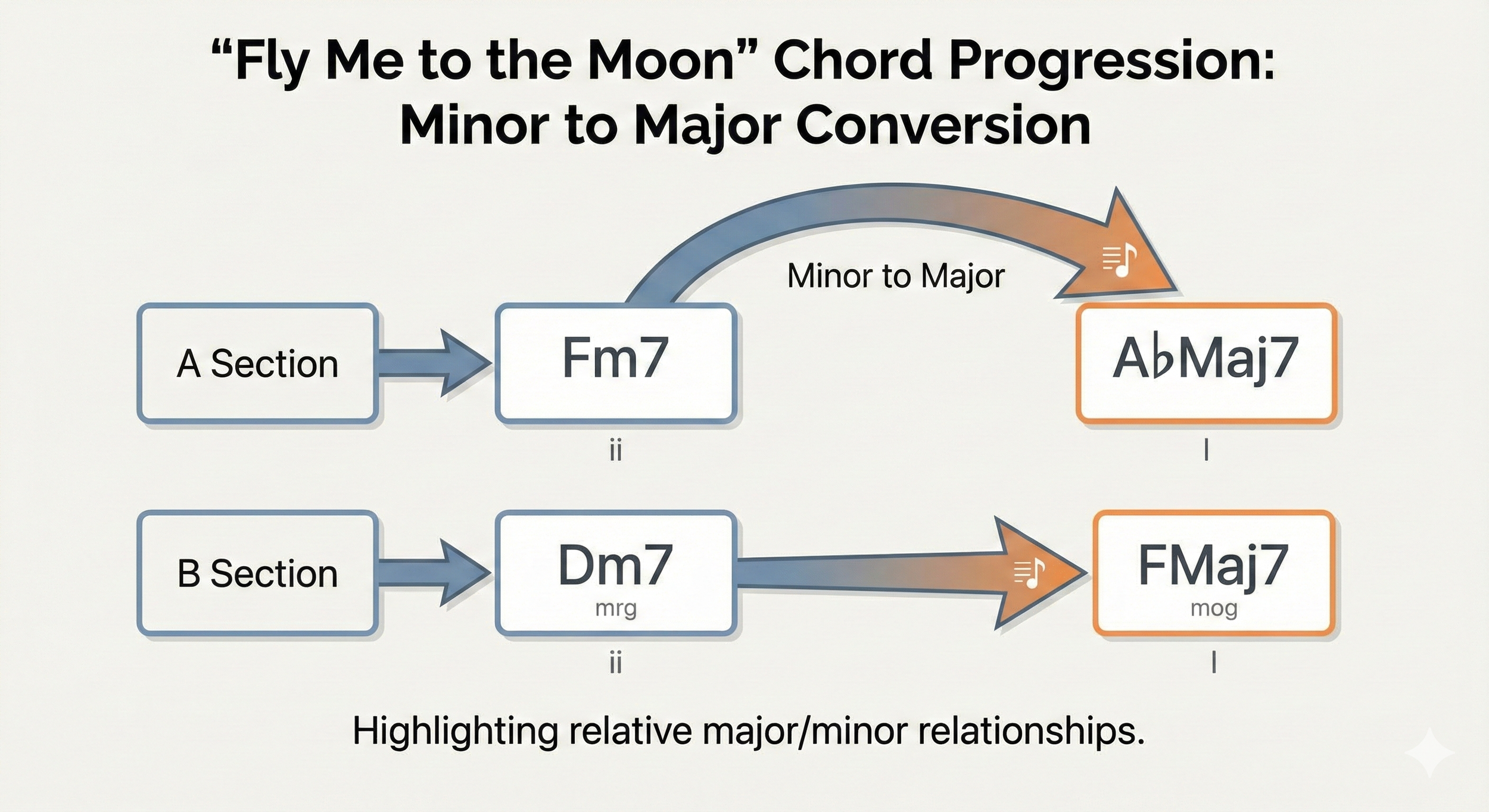
Stop looking at the chord symbol as a rigid instruction and start seeing the functional harmony above it. By substituting the basic minor chord with its relative major upper structure, you instantly access a more colorful, professional sound. For detailed diagrams and the "How to Learn Tunes " framework, go to VoiceLidJazzGuitar.com.