

Jazz Guitar Chords for Beginners: Do You Need to Memorize Every Chord and Tension?
You don't need to memorize every jazz chord and tension to start. Learn one connected system — shell voicings on a ii-V-I, then the guide tones inside them — and reuse it on every tune you play.
Why Do Your Comping Chords Sound Empty Compared to Your Solo Lines?
A bare triad sounds full and confident in a solo line, but hollow the moment you use it to comp behind yourself. The missing ingredient is the guide tones — the 3rd and 7th that actually tell your ear which chord you're on.

How Do You Fill the Space Between Chord Tones? Connect the 3rds First
To fill the space between chord tones, build the skeleton first: connect the 3rd of each chord, cross through the 7th on the way, and fill the remaining gaps with scale notes — saving the target note for last. The melody of Fly Me to the Moon is built on exactly this mechanism, which means the fill notes were never random.
Why Don’t Jazz Guitarists Play the Root of the Chord?
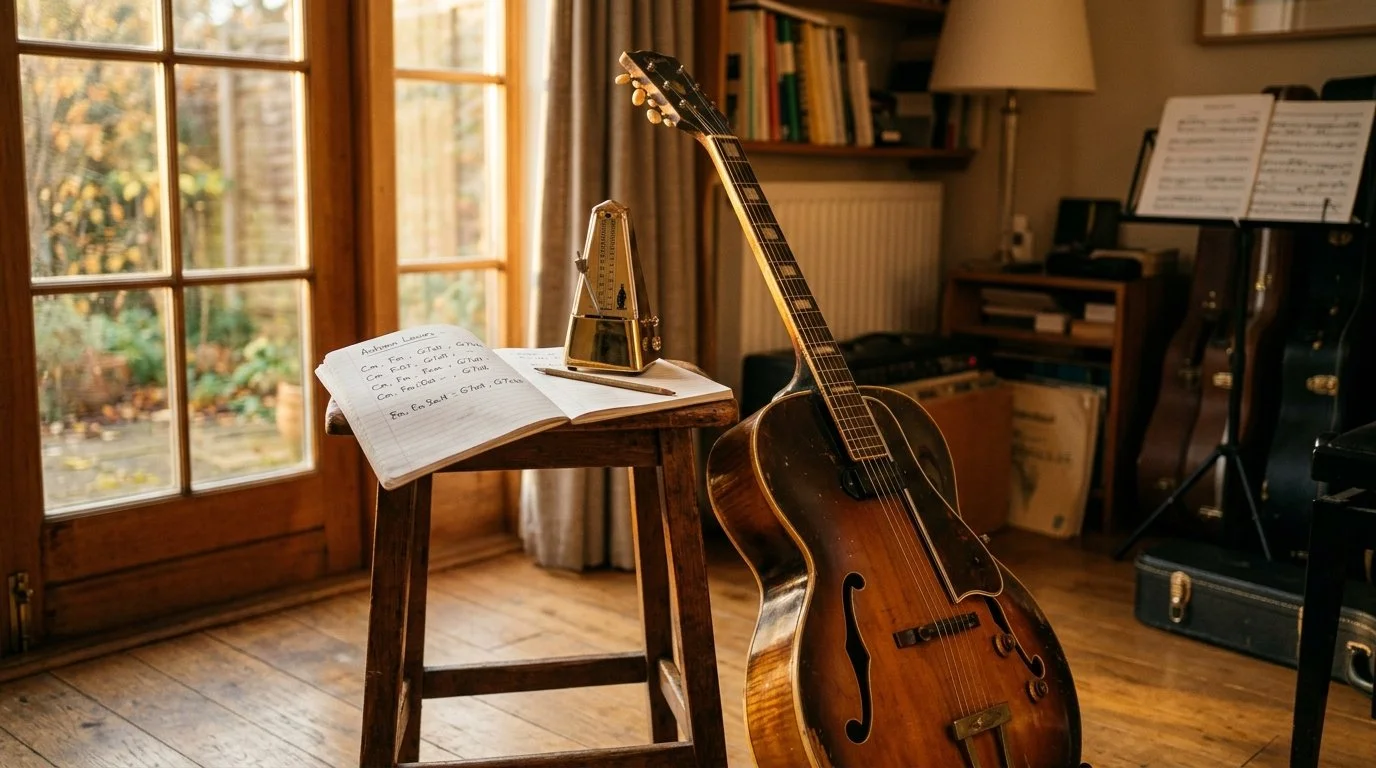
Jazz guitarists leave the root out because the bass player already has it. The 3rd and the 7th are what actually make a chord sound like itself — learn those two notes first, and every richer voicing you want later grows out of them.

Do You Start Improvising on Autumn Leaves? Melody Plus the One Note That MovesHow
Your first real solo on Autumn Leaves is not a scale run. It's the melody combined with the guide-tone line — the single note that moves between each pair of chords. That combination alone produces a complete, musical chorus.

What Key Do You Solo In on Autumn Leaves? Neither — Follow the Melody
Autumn Leaves is analyzed in C major, but you don't solo from a key center — not C major, not A minor. You solo from the melody and the guide tones, the way the composer wrote the tune.
t Notes Do You Play in a Jazz Solo? The Melody Already Drew the MapWha
The strongest notes in a jazz solo are the 3rds of each chord — and in most standards the melody already lands on them. Learn the framework line and soloing stops being a guessing game.

How Do You Build a Jazz Solo? Start With a Framework Line, Not a Scale
A jazz solo isn't a scale poured over chords — it's built in layers. Start with a framework line of guide tones, then add upper structures, Wes and Django lines, and approach notes.

Which Notes Matter Most for Voice Leading? The Melody Already Told You — It’s the 3rd
The most important voice-leading note over each chord is almost always the 3rd — and in most standards the melody is already sitting on it. Fly Me to the Moon, All The Things You Are, and Autumn Leaves prove it chord after chord.

lo Over All The Things You Are Without Thinking in Scales? Five Chords, Two ShapesHow Do You So
The first five chords of All The Things You Are reduce to two upper-structure shapes: Fm7 becomes A♭maj7, B♭m7 becomes D♭maj7, and E♭7 is just D♭maj7 with one note lowered. Here is the full walkthrough plus the diatonic circle-of-fifths practice sequence.

Voice Leading on Jazz Guitar: Why the Guide Tones Follow the Melody
On jazz guitar, voice leading works because usually only one note moves between chords — and that moving guide tone lines up with the melody. Here's how to see it and practice it on standards.

Jazz Guitar Voice Leading: Soloing Through I’ll Be Seeing You With Guide Tones and the Wes Line
To solo with voice leading on I'll Be Seeing You, treat the Ebmaj7 as a Cm6, choose your fretboard position with the Wes Line, and move guide tones smoothly between chords. The first eight bars and second eight share the same voice-leading shape.

Voice Leading Guitar: Why a Chord Changes When Only One Note Moves
A chord doesn't change because every note changes — it changes when a single note moves. That one idea, practiced through triad cycles and circle-of-fifths shell voicings, is the heart of voice leading on guitar.

Why the Major 7th Clashes With the Melody — Use the 6 Chord Instead
Most jazz standards end on the root in the melody, and a major 7th chord underneath clashes with that note. Swap the maj7 for a 6 chord and the voicing supports the melody instead of fighting it.

Jazz Guitar Chords for Beginners: Why You Should Drop the 5th First
Most beginners try to play full seventh-chord shapes and get tangled in fingerings. The traditional jazz answer is to drop the 5th and keep only the root, 3rd, and 7th. Here is why that one decision is the cleanest first step into real jazz guitar.
Stop Playing Roots: The Power of Shell Voicings for Beginners
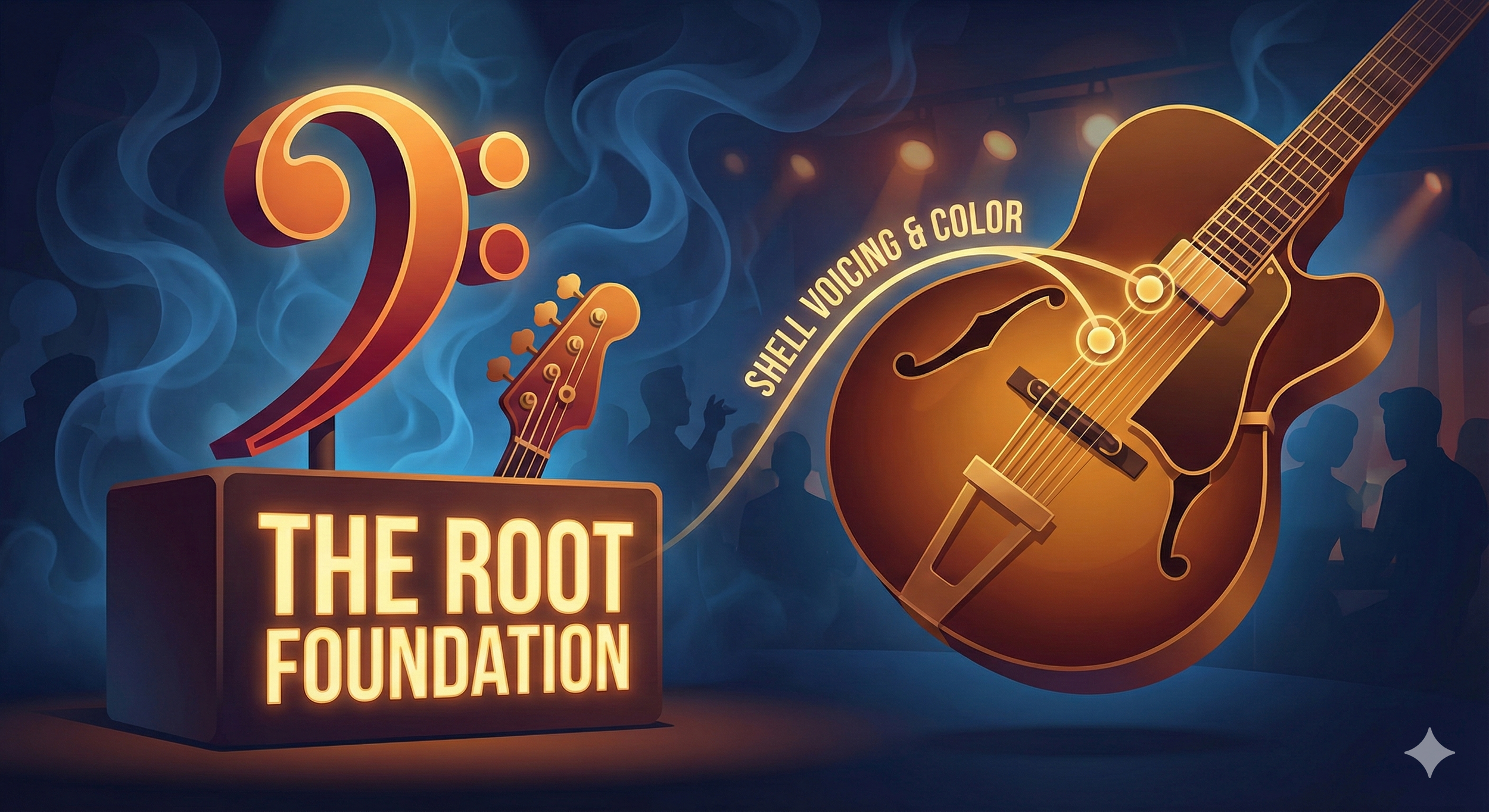
Transitioning to jazz guitar? Your obsession with anchoring on root notes might be muddying the mix. The bass player has the foundation covered. Your job is to define the color. Discover why stripping your chords down to just the 3rds and 7ths—Shell Voicings—is the key to unlocking smooth voice leading and that sophisticated "jazz sound."

Stops Chasing Roots: The Magic of Guide Tones and Voice Leading
One of the biggest struggles for jazz guitar beginners is that their solos sound disconnected. Do you find your hand jumping frantically from one end of the fretboard to the other? It feels like a game of "Whac-A-Mole." Discover why chasing roots is inefficient and how mastering "Guide Tones" will transform your playing into smooth, storytelling solos.
Breaking Through Your Improvisation Rut: A Practical Guide to Connecting Melody and Guide Tones
You know your scales and chord tones—but your improvisation still doesn’t sound musical.
The missing link isn’t more theory. It’s learning how to connect melody and harmony through guide tones, voice leading, and simple triadic movement inside a real song.