
Stops Chasing Roots: The Magic of Guide Tones and Voice Leading
Stop Playing "Whac-A-Mole" with Roots One of the biggest struggles for jazz guitar beginners is that their solos sound disconnected. When the chords change, do you find your hand jumping frantically from one end of the fretboard to the other, chasing the root notes? It feels like a game of "Whac-A-Mole." As mentioned in my livestream, chasing roots is the least efficient way to play jazz guitar. The bass player is already playing the roots perfectly. Your job is to tell a story on top of that foundation.
For a foundational look at guide tones and shell voicings, see Breaking Free from Scale Blocks: A Beginner's Guide to Shell Voicings.
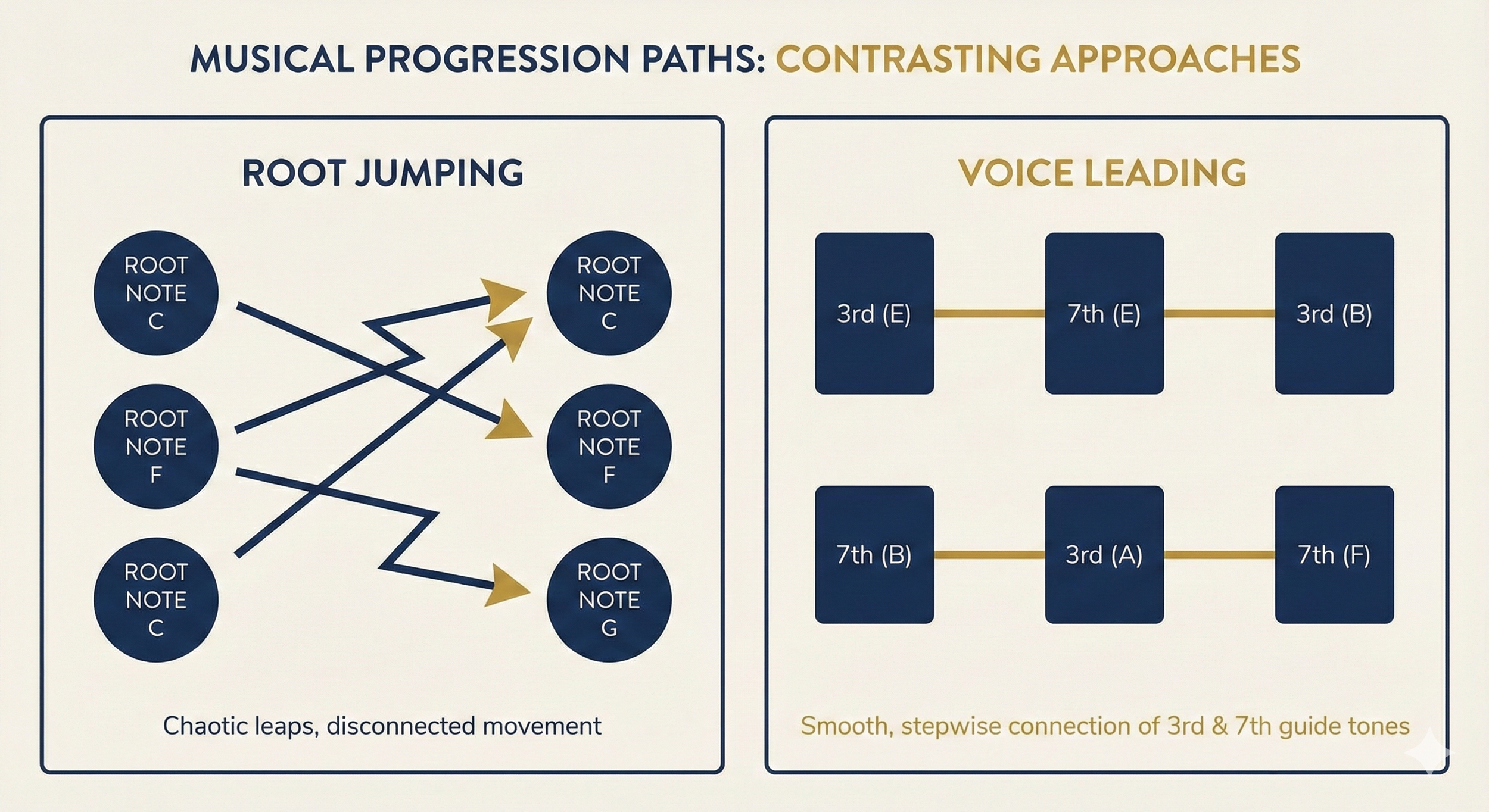
The compass that guides this story is what we call "Guide Tones."The Concept: Guide Tones & Common Tones The two most critical notes in jazz harmony are the 3rd and the 7th. The 3rd determines the quality (Major vs. Minor), and the 7th determines the function (Stable vs. Moving). If you analyze standard jazz progressions like the II-V-I, you'll discover a secret: specific notes move very little.
For a complete map of how guide tones function across chord types, the Bridge Theory Reference page lays it out clearly.
• The 7th of the Dm7 (C) moves down just one half-step to become the 3rd of the G7 (B).
• The 7th of the G7 (F) moves down just one half-step to become the 3rd of the Cmaj7 (E).
This smooth transition is called Voice Leading. In my Q&A, I demonstrated a "Common Tone" exercise using the complex changes of The Girl from Ipanema. The idea is to find one note that fits over multiple changing chords or moves only by a half-step. Instead of jumping around, you create a smooth, singing line—like an alto or tenor voice in a choir.
Connect, Don't Jump For your practice today, take a backing track and try to play a solo using only long notes. Find the "Common Tone" that bridges two chords. Find the half-step connections. Stop jumping with your eyes; start connecting with your ears. This small shift in perspective is the biggest step away from sounding like a beginner. For more in-depth lessons voice leading and fretboard navigation, visit VoiceLidJazzGuitar.com.