
The Only Cheat Sheet You Need for Rhythm Changes: Deep Listening & Playlists
The Mountain of "Rhythm Changes"
For intermediate jazz players, "Rhythm Changes"—the chord progression based on George Gershwin's I Got Rhythm—is a formidable rite of passage. Tunes like Oleo, Dexterity, and Cottontail are staples of the jam session, often played at breakneck tempos. When a student approaches me saying, "I want to master Rhythm Changes," their first question is usually about scales or arpeggios. "What notes do I play over the bridge?" However, based on my studies with Richie Hart and my time at Berklee, I can tell you that the cheat sheet isn't a scale chart. The only true cheat sheet is a curated playlist.
The Building Blocks course gives you the foundation you need before diving into Rhythm Changes.
For a deeper dive on this idea through Jim Hall’s lens, see Decoding Rhythm Changes: Raw Blues Instinct and the Genius of Jim Hall.
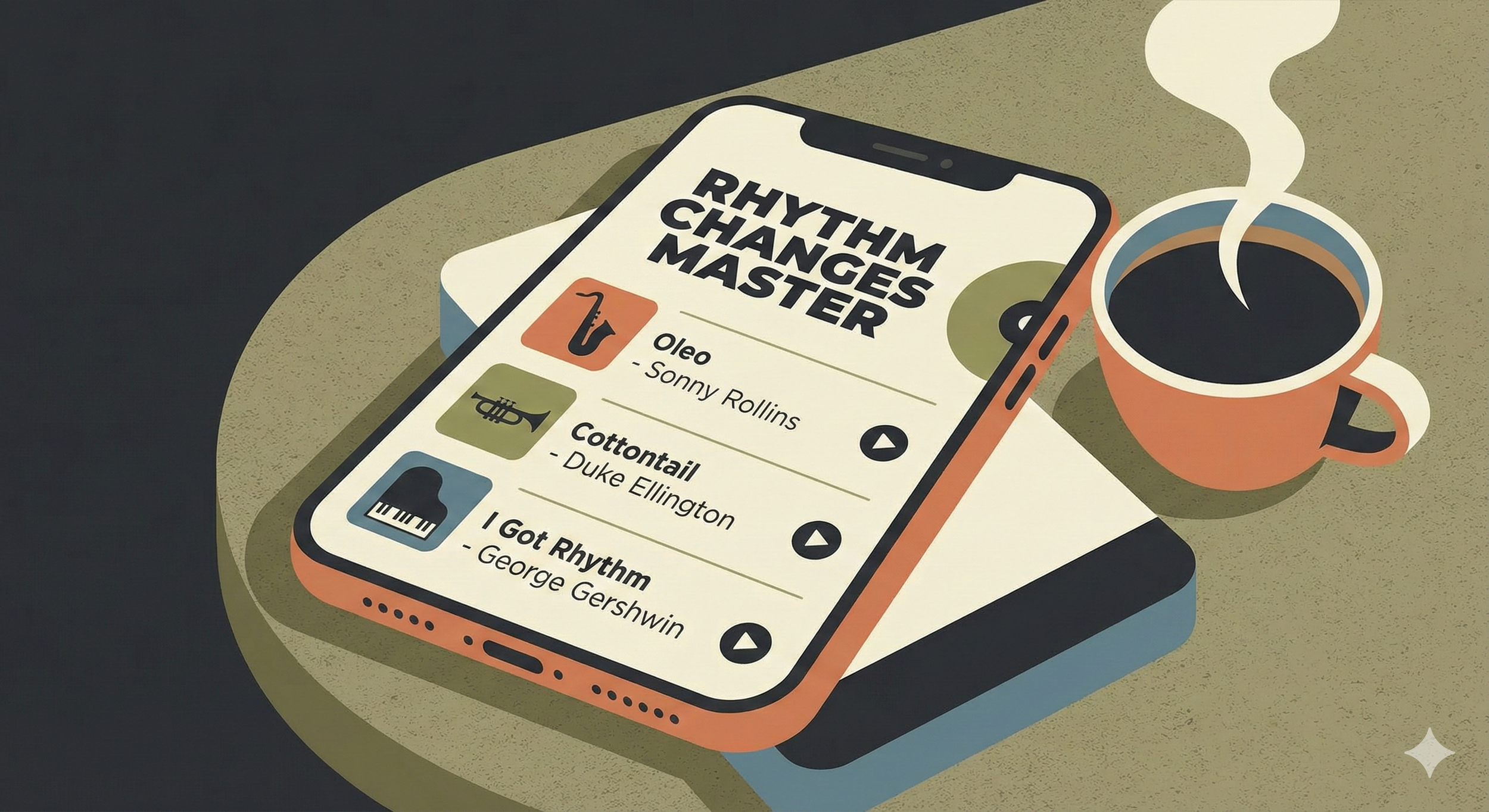
Deep Listening: Training the Ear Before the Hands
When playing uptempo tunes, you do not have time to think, "Okay, this is Bbmaj7, now G7alt, now Cm7." If you are thinking, you are dragging. The form must be internalized to the point of instinct. To achieve this, you need Deep Listening.
1. Curate: Search for "Rhythm Changes Tunes" and create a playlist of 10-20 versions (guitar, sax, piano).
2. Immerse: Listen to this playlist exclusively. While driving, eating, or walking.
3. Internalize: Eventually, you will stop hearing individual songs and start hearing the "Flow." You will instinctively feel when the A section ends. You will feel the shift in tension when the Bridge (B section) begins its cycle of dominant chords. Masters like Wes Montgomery or George Benson didn't play fast because they had faster neurons for calculating scales. They played fast because they "heard" the form perfectly. They were composing melodies over a structure that was as familiar to them as their own backyard.

Build Your Cheat Sheet
Create your "Rhythm Changes Master" playlist today. Before you practice a single lick at 250 BPM, wash your ears in the sound of the changes. Once your ear knows the road map without looking, your fingers will naturally find the way. Technique supports what the ear hears; it cannot replace it. For more on structuring your practice, visit VoiceLidJazzGuitar.com.