
Are You Just Memorizing Shapes? How to Truly Understand the Fretboard with Chord Degrees
Breaking Free from the Endless Cycle of Memorization
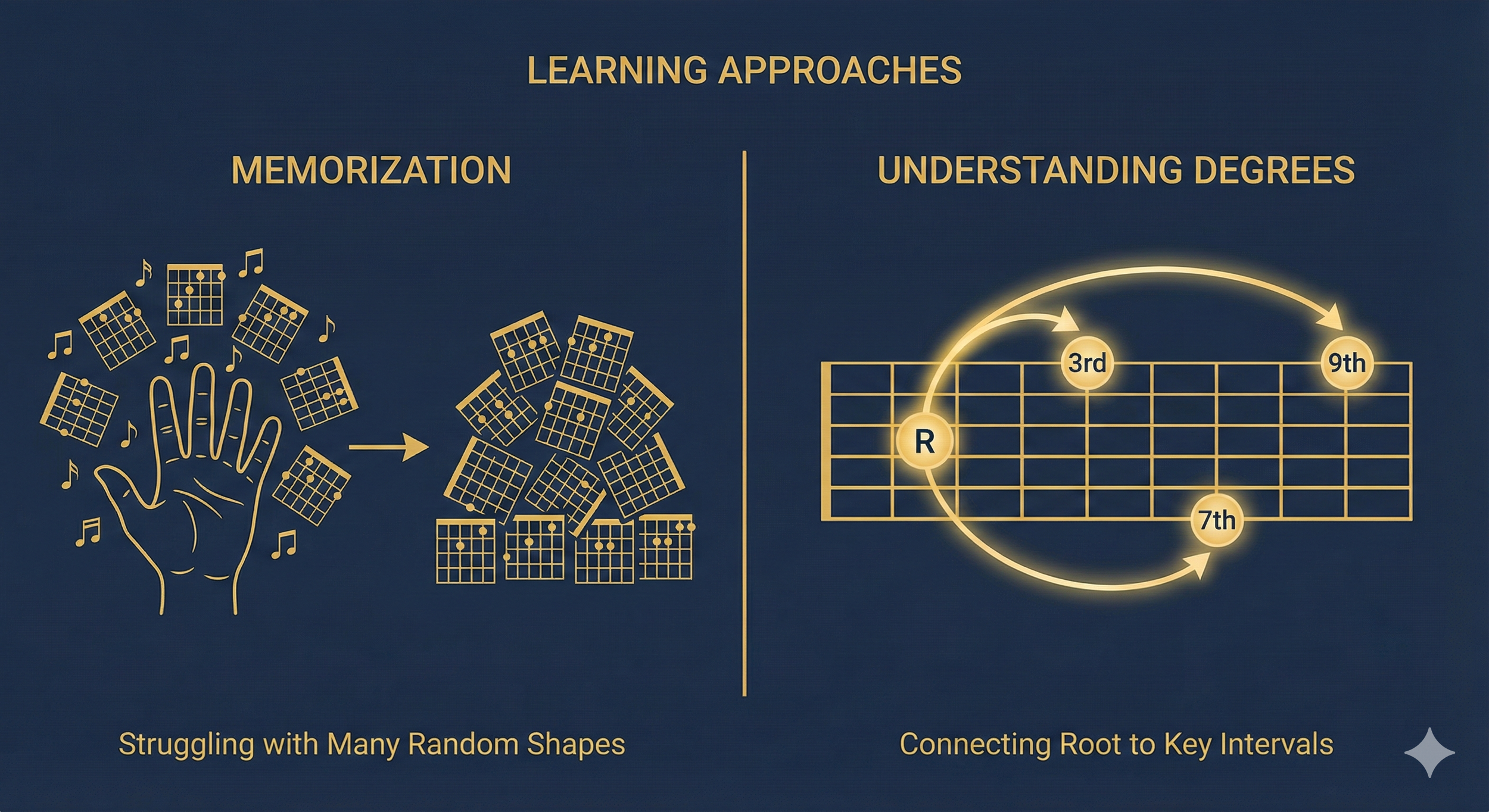
When you first venture into jazz guitar, the sheer number of chord charts can feel overwhelming. Major sevenths, minor sevenths, dominant sevenths... just when you think you've memorized the shapes, unfamiliar numbers like #9 and b13 appear, plunging you into confusion. It can feel like a relentless memorization game, causing many to abandon their guitars in frustration. But what if you could understand chords not as mere 'shapes,' but as a 'language'? Today, let's move beyond rote memorization and talk about 'degrees'—the key to unlocking the true meaning of chords across the fretboard.
If you've felt this 'connect the scales' instinct before, see Why Connecting Scale Shapes Won't Help You Play Jazz Changes.
What Are Degrees, and Why Do They Matter?
During the Q&A session in the source transcript, a viewer asked a crucial question: "Do you recognize all the degrees when you play a chord?" My answer was, "Yes, to a certain extent." This doesn't mean I've memorized the letter name of every single note on the fretboard. It's about understanding function. Let’s take an F minor chord as an example. One fingering might place the 9th as the top note (the melody), while another shape might feature the 11th. To perceive the fretboard in 'degrees' means understanding how far each note is from the root and what 'function' or 'color' it provides. It’s about seeing the architecture of the sound, not just the physical shape your hand makes.
If you want to understand how the diagonal system organizes the fretboard by function rather than shape, Fundamental 1: Wes Diagonal System maps it out completely.
1. The Skeleton of a Chord: The 3rd and 7th: The identity of any seventh chord is defined by its 3rd and 7th. These two notes alone are enough to convey its quality (major, minor, or dominant). Just by practicing finding the 3rd (E) and 7th (B) of a Cmaj7 chord, or the 3rd (B) and 7th (F) of a G7, the fretboard will begin to look far less intimidating and much more logical. This is the very foundation of shell voicings.
2. Adding Color with Tensions: Tensions like the 9th, 11th, and 13th are the spices that add rich, complex flavors to your chords. Adding a flat ninth (b9) to a G7 chord creates a tense, dramatic sound, while a natural thirteenth (13) gives it a bright, sophisticated feel. When you understand these tones by their degree, you move from being a passive player who simply presses shapes written on a chart to an active musician who can create specific sonic moods at will.
3. The Foundation for Chord Melody and Soloing: When you know what degree of the chord your melody note is, you can build beautiful voicings underneath it to support it harmonically. This is the heart of chord-melody playing. Furthermore, when improvising, targeting the 3rd or 7th of an upcoming chord is a classic technique for creating strong, logical lines that resolve satisfyingly. Understanding degrees gives you a map for your improvisational journeys.
Start Seeing Functions, Not Just Shapes
Learning to see the fretboard in terms of degrees won't happen overnight. It requires conscious effort and consistent practice. However, if you stick with it, the scattered dots on the fretboard will begin to connect into meaningful lines and structures. For your practice session today, try just one thing: take a II-V-I progression from your favorite standard and, for each chord, find and play only its 3rd and 7th. It might feel slow and clumsy at first, but this small, deliberate habit will elevate your entire journey in jazz guitar to a completely new level. To dive deeper into jazz harmony and improvisation, visit VoiceLidJazzGuitar.com and explore the structured curriculum.