
Starting Jazz Guitar? Here’s Who You Must Listen to First (Feat. Wes Montgomery)
The Overwhelming First Step—Who Should I Listen To?
So you’ve decided to dive into the world of jazz guitar. The fantasy of playing beautiful, flowing solos is exhilarating, but it often comes to a screeching halt with a single, daunting question: "Who should I actually listen to?" Lost in a sea of legendary names, it’s easy to feel overwhelmed. To help you navigate these initial steps, we’ll introduce you to the ultimate signpost for any aspiring jazz guitarist: the one and only Wes Montgomery.
If you want to go deeper on Wes Montgomery's approach, see How Wes Montgomery Actually Read the Fretboard.
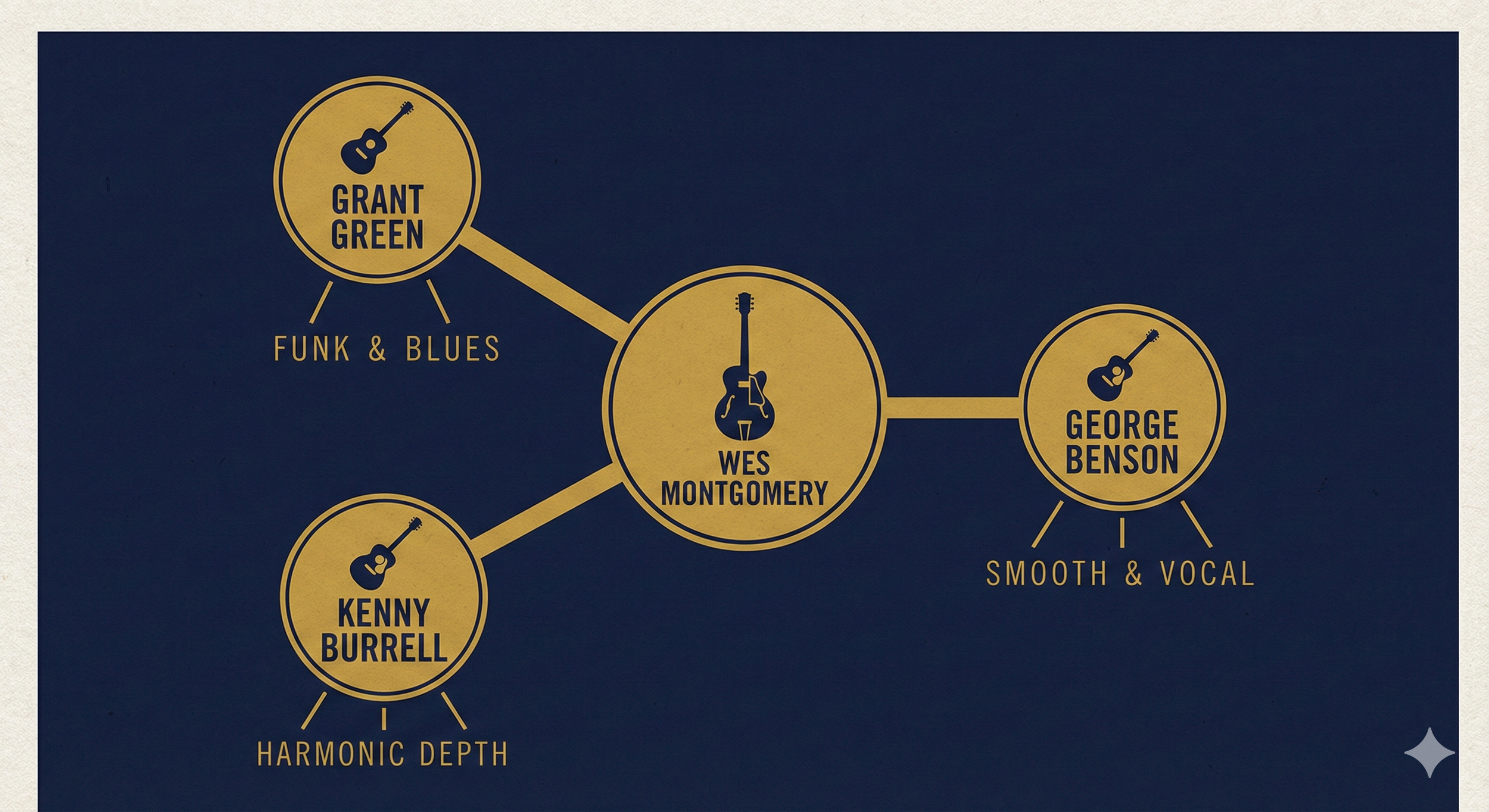
JAzz Guitar starter map
The Main Course: Why All Roads Lead to Wes Montgomery
"Even my grandmother knows who Wes Montgomery is." A friend of mine at Berklee College of Music once said this, and it wasn't an exaggeration. Wes was one of the first jazz musicians to achieve massive commercial success, bringing the genre to a mainstream audience. His music, while founded on a deep and sophisticated understanding of harmony, is filled with beautiful, accessible melodies that instantly capture the listener's ear. His signature 'octave' technique, which produces a warm and full-bodied tone, became iconic through his renditions of famous pop tunes like "California Dreaming" and "Sunny." Unlike the fast, complex pyrotechnics of Bebop, these songs are approachable, allowing beginners to listen comfortably and even feel inspired to try playing them. Listening to Wes is more than just appreciating good music; it's like learning the most elegant and foundational grammar of the jazz guitar language. Once you’ve familiarized yourself with Wes, you can start exploring the branches of the jazz guitar family tree. Here are a few essential artists to check out next:
If you want to go deeper on Wes Montgomery’s approach, Wes’ Insight breaks down the exact fretboard logic that made his sound so distinctive.
1. Grant Green: Known for his blues-drenched, intuitive phrasing. Grant Green’s style is more concise and soulful than Wes's. He’s an excellent guide for players who want to inject a heavy dose of blues feeling into their jazz vocabulary. His lines are direct, rhythmic, and deeply rooted in the blues tradition.
2. Kenny Burrell: The master of sophisticated and elegant playing. Burrell masterfully blends blues and bebop, creating a refined, urban sound. His academic depth is equally impressive, as he has served as the director of jazz studies at UCLA for many years. His playing is the epitome of taste and class.
3. George Benson: Often seen as a direct descendant of Wes Montgomery, George Benson is famous for his blistering speed, incredible rhythmic drive, and signature scat-singing solos that he plays in unison with his guitar lines. His music is a celebration of the joy and energy of jazz. Of course, the list doesn't end there. The history of jazz guitar is rich with innovators, from Charlie Christian, often credited as the first electric jazz guitarist, to modern masters like Jim Hall and the late, great Pat Martino. However, when you're just starting, having a clear anchor is more important than knowing every name. By starting with Wes Montgomery, you train your ear and establish a solid foundation. From there, you can trace his influence and discover a whole universe of incredible players.

Wes’ Octave on fretboard. (sorry for the 7 string guitar, Gemini can’t fix it)
Play Your Life Story
In our quest for perfection, perhaps we miss the point. A performance filled with your own story, even if slightly flawed, can move a listener more deeply than a technically flawless but sterile solo. How was your week? Why not take a moment to play a song that can become a time capsule for your feelings—the joys, the disappointments. The music that is imbued with your life is the most original and beautiful music in the world. For more inspiration on the intersection of music and life, visit Bridge: Theory and Bridge: Sound