
Improvisation Myths: Why Chords Matter More Than Scales (feat. Fly Me to the Moon)
Why "Correct" Note Choices Sound Boring
A common frustration among intermediate jazz guitarists involves playing "correct" notes but lacking the authentic jazz sound. You see a Dm7, so you play D Dorian. You see G7, you play G Mixolydian. Mathematically, you are correct. Musically, however, it often sounds like you are just running scales up and down the neck. The harsh truth is: Improvisation is based on chords, not scales. Think about the band context. Your bassist is already hammering the Root on beat one. Playing the root in your solo is redundant. The 5th is often harmonically neutral and naturally occurs as an overtone. What’s left? The 3rd and the 7th. These are the Guide Tones—the DNA of the chord that determines its quality (Major vs. Minor, Dominant vs. Major).
If you want to apply this concept to real standards, June’s Song Book has Fly Me to the Moon and other essential tunes to practice with.
Case Study: Fly Me to the Moon
Let’s analyze the standard Fly Me to the Moon in the key of Ab major. The progression typically moves through the circle of fifths:
Fm7 - Bbm7 - Eb7 - AbMaj7. If you just noodle around in the Ab major scale over these changes, you miss the harmonic propulsion. To sound like a pro, you must voice-lead the changes. Let’s look at the guide tones:
• Fm7: 3rd is Ab, 7th is Eb.
• Bbm7: 3rd is Db, 7th is Ab.
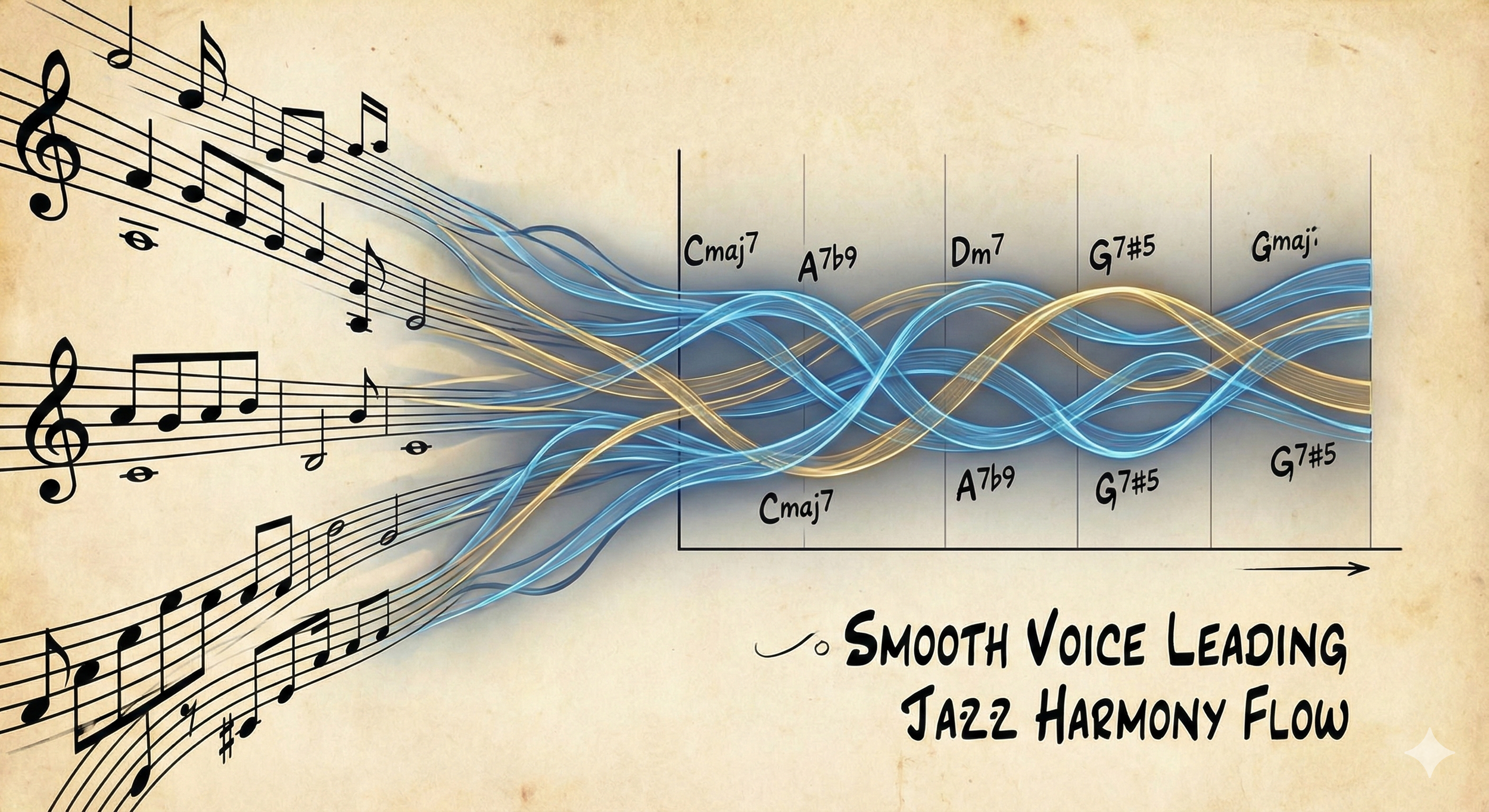
Notice the movement? When moving from Fm7 to Bbm7, the Ab note (3rd of Fm7) stays exactly where it is to become the 7th of Bbm7. That is a Common Tone. However, the Eb (7th of Fm7) must move down to become the Db (3rd of Bbm7). This is the golden rule of functional harmony voice leading: When chords change in standard cycles, one guide tone stays, and the other moves. As an improviser, your job is to highlight that movement. If you target the note that changes, you clearly outline the harmony to the listener. If you just play scale runs, the listener has to guess where the changes are. In my live sessions, I demonstrate how aligning your solo lines with these shifting guide tones—similar to how the original melody interacts with the harmony—makes your solo sing rather than ramble.
I've previously analyzed Blue Bossa from a functional-harmony angle in Deconstructing Harmony: A Functional Analysis of 'Blue Bossa' with Upper-Structure Triads.
Leave the Roots to the Bass Player
To advance from an intermediate player to a sophisticated one, shift your focus from vertical scales to horizontal chord tones. Stop trying to match a mode to every chord symbol. Instead, visualize the highway of 3rds and 7ths connecting across the fretboard. Don’t fight the bassist for the low ground. Let them have the roots. Your territory is the color tones. Start mapping these out on tunes like Autumn Leaves or Fly Me to the Moon, and you will find your solos becoming instantly more melodic and structured. For full lessons on Shell Voicings and Guide Tone mapping, visit VoiceLidJazzGuitar.com.