
Decoding Wes: Upper Structures and Reverse Picking Mechanics
Beyond the Notes
Advanced jazz guitar is not just about speed; it's about harmonic depth and physical mechanics. To truly sound like a pro, one must investigate the logic behind the lines of legends like Wes Montgomery and the mechanical precision of George Benson. In this post, we analyze a specific harmonic superimposition used by Wes in Fly Me to the Moon and the unorthodox picking technique that defines the Benson sound.
If you want to go deeper on Wes Montgomery's approach, see How Wes Montgomery Actually Read the Fretboard.
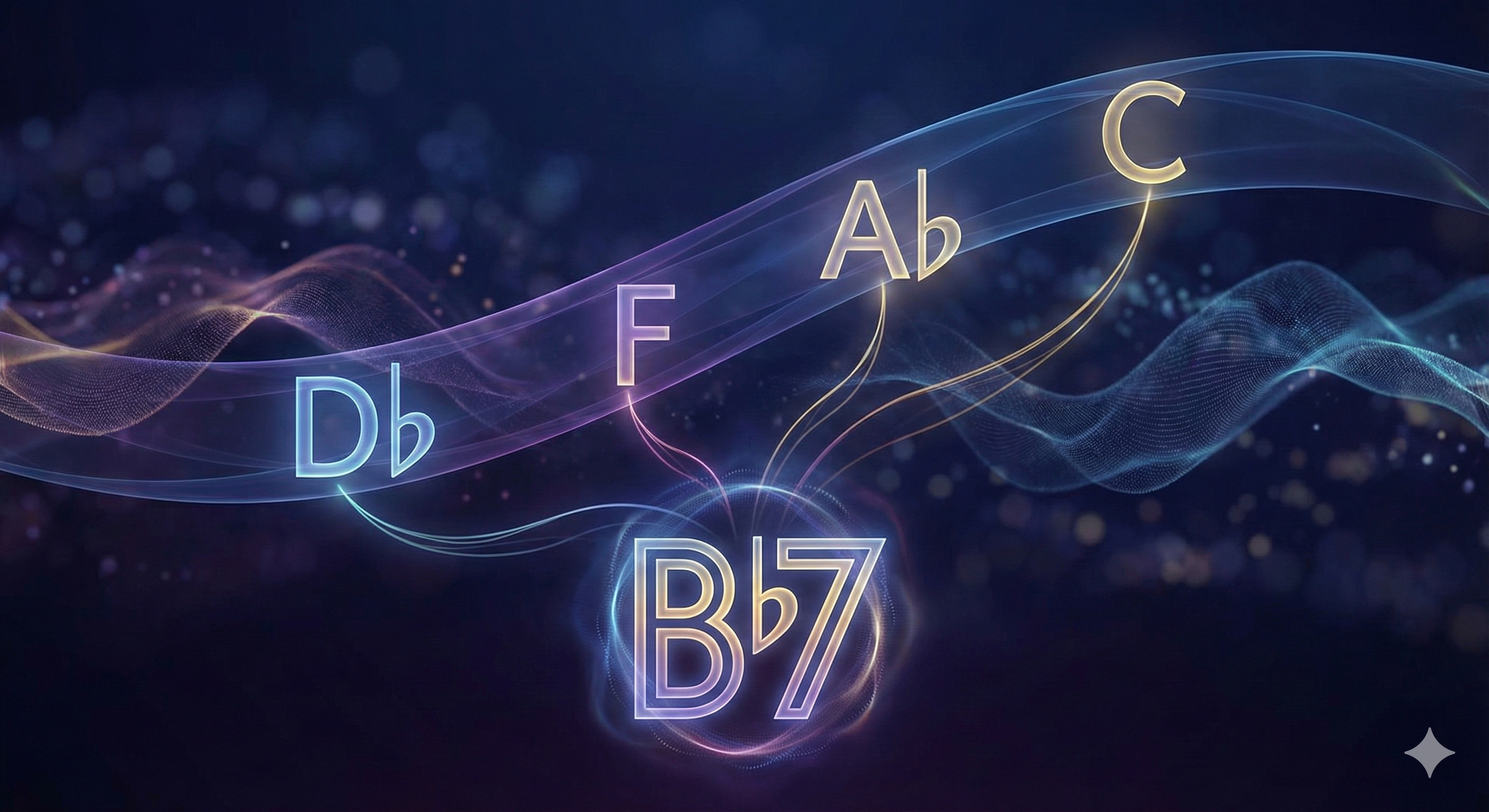
The Harmonic Architect: Wes Montgomery's Superimposition
When analyzing Wes Montgomery’s lines, you realize he rarely plays just the "written" chord. He views harmony through the lens of Upper Structures and Superimposition. Let’s look at a II-V-I progression in Eb:
Fm7 - Bb7 - EbMaj7
Instead of just running a Mixolydian scale over the Bb7, Wes might superimpose a completely different chord shape.
• The Db Major 7 Substitution: Over the Bb7 chord, playing a Db Major 7 arpeggio yields the intervals: Root (becomes the b3 of Bb), 3rd (5th), 5th (b7), and 7th (b9). This instantly creates a sophisticated Altered Dominant sound (Bb7b9) by playing a simple Major 7 arpeggio a minor third up.
• The Relative Minor/Major relationship: Wes also treats Minor 7 chords (like Gm7) as Major 6 chords (Bb6) rooted a minor third up. This fluidity allows him to apply familiar melodic shapes in unexpected harmonic contexts.Mastering this means seeing the fretboard not as static dots, but as layers of shifting harmonic plates. The Mechanical Engineer: George Benson's Picking Tone is in the hands. Having started as a thumb player (using Rest Strokes to drive the guitar top), transitioning to a pick required maintaining that fat, powerful tone. This led me to the George Benson Picking Method. Most guitarists angle the pick slightly towards the neck (positive angle). Benson, however, angles the pick effectively backwards (negative angle) relative to the strings. Why does this matter?
1. Articulation: This angle allows the pick to glide over the strings with less resistance, enabling incredible speed.
2. Toen: Coupled with a "Rest Stroke" mentality (driving through the string until resting on the next), this technique produces a punchy, staccato articulation that mimics the weight of a thumb stroke but with the precision of a plectrum.

To play like a master, think like a composer and an engineer. Engineer your picking hand for maximum efficiency and tone, and compose your lines using advanced harmonic substitutions. Experiment with superimposing Major 7 arpeggios over dominant chords to unlock that modern jazz sound. For deep dives into these concepts, visit VoiceLidJazzGuitar.com.