
The 12-Key Trap: Why Trying to Conquer Every Key in Order Is Doomed to Fail
Master of C Major, Stranger to F# Major
For the intermediate jazz guitarist, practicing in all 12 keys is the Holy Grail. We envision ourselves fluently navigating II-V-I voicings, scales, and arpeggios in any key, so we ambitiously start the Circle of Fifths, beginning with C major. C, F, Bb, Eb... the first few keys feel manageable. But around Ab major, our brains get foggy and our fingers start to tangle. By the time we finally reach B or F# major, the muscle memory for C major has all but vanished. Why do we get stuck in this infinite loop of 'conquer and forget'? Today, we'll analyze the common trap of 12-key practice and propose a smarter, more musical alternative.
If you've felt this 'connect the scales' instinct before, see Why Connecting Scale Shapes Won't Help You Play Jazz Changes.
If you want a structured way to apply this discipline, see How to Build a Jazz Guitar Practice Routine in 10-Minute Blocks.
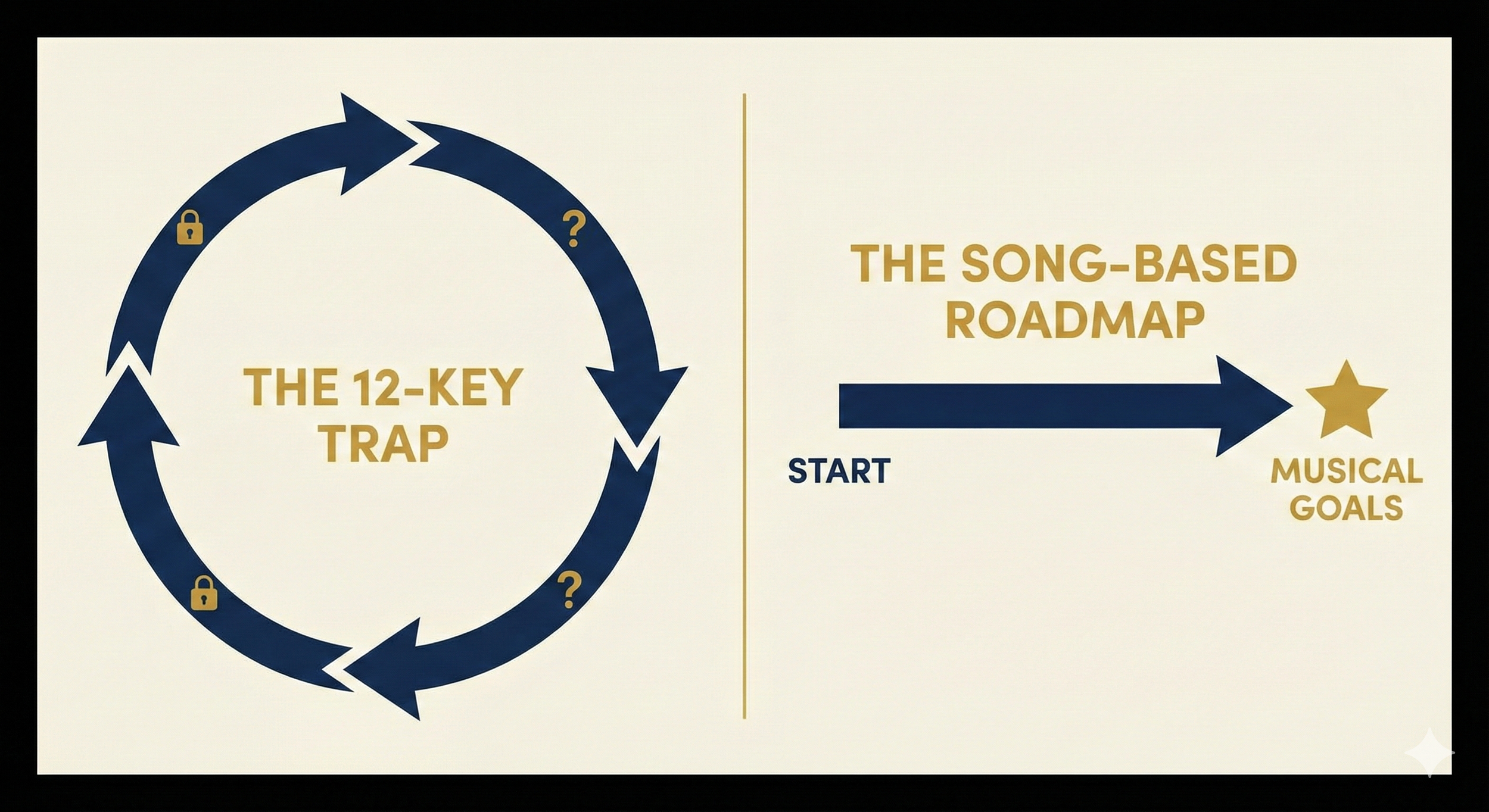
Song than 12 Keys practice
The Main Concept: Knowledge Without Context Evaporates
Practicing keys sequentially is like basic physical conditioning—important, but disconnected from the 'actual game' (the music). The real reason we need to know shell voicings in Ab major is to someday play the bridge of All the Things You Are. But when we remove that context from our practice and turn it into an abstract exercise called 'Ab Major Drills,' our brain doesn't register the information as important, and it quickly discards it.
The smarter approach is to reverse the order. I call it "Song-Based Gradual Expansion."
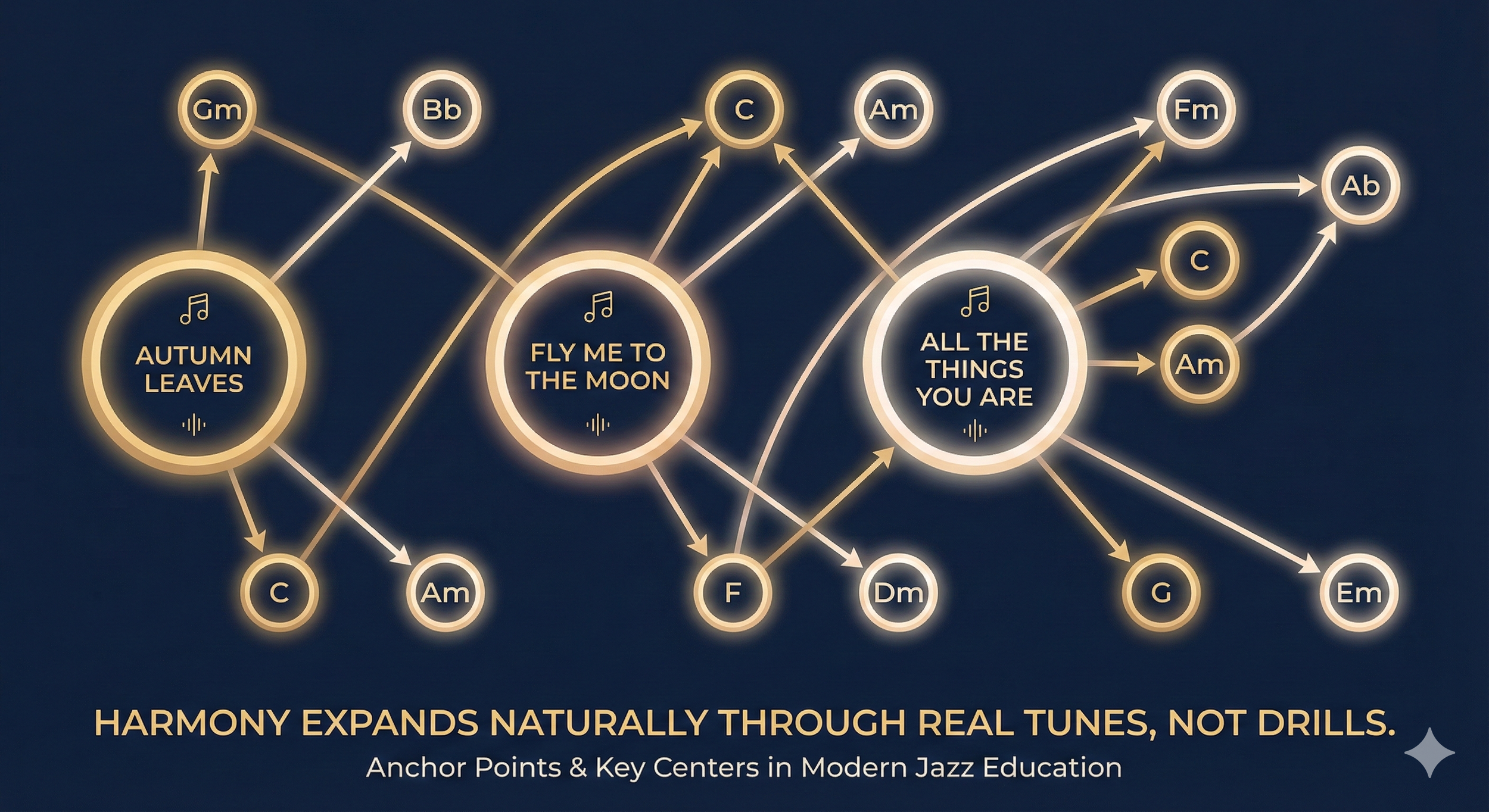
Set Your Anchor: Instead of tackling all 12 keys at once, target a single song you're currently learning—for example, Autumn Leaves. This tune primarily operates in G minor and its relative, Bb major.
Target Only What You Need: Now, your goal isn't to 'conquer 12 keys.' It's to 'master the II-V-Is in G minor and Bb major.' You focus intensely on the shell voicings, triads, and scales that appear in these keys. This knowledge will stick because it's connected to a powerful 'musical anchor': the song Autumn Leaves.
Expand Naturally: Let's say your next project is Fly Me to the Moon in C major. Now, you add C major and its related keys (Am, Dm, G) to your map. As you add songs to your repertoire, your knowledge organically and robustly expands to cover all 12 keys. This is the power of the 'top-down' learning approach.
This method provides an immediate 'musical payoff' for every moment of practice. Your time is no longer spent on abstract drills but is directly invested in expanding the list of songs you can actually play.
Conclusion: Your Songbook is Your Best Textbook
Don't be discouraged by the intimidating mountain of 12 keys. The jazz standards you love are the surest and most enjoyable trails to lead you to the summit. Start by assembling the pieces you need for the song in front of you today. As your repertoire grows, your musical world will expand right along with it.
For systematic methods on conquering harmony through tunes, check out more tips at Bridge: Theory and Bridge: Sound.