
Beyond Lineage: The 'All-Weather Virtuoso' in Modern Jazz Guitar (A Jesse van Ruller Case Study)
Are You from the 'House of Benson' or the 'House of Green'?
In the world of advanced jazz guitar, we often frame a player's style by their lineage. We talk about explosive bebop lines influenced by George Benson, or bluesy, soulful phrasing that carries the DNA of Grant Green. This framework is essential for understanding a musician's identity. However, the modern jazz scene is producing "all-weather" virtuosos who transcend these clear-cut distinctions, absorbing and reinventing the strengths of multiple lineages. Through the case of Jesse van Ruller, mentioned in the source transcript, we can undertake a deeper consideration of the multi-dimensional spectrum required of a modern jazz guitarist.
If you want a structured way to apply this discipline, see How to Build a Jazz Guitar Practice Routine in 10-Minute Blocks.
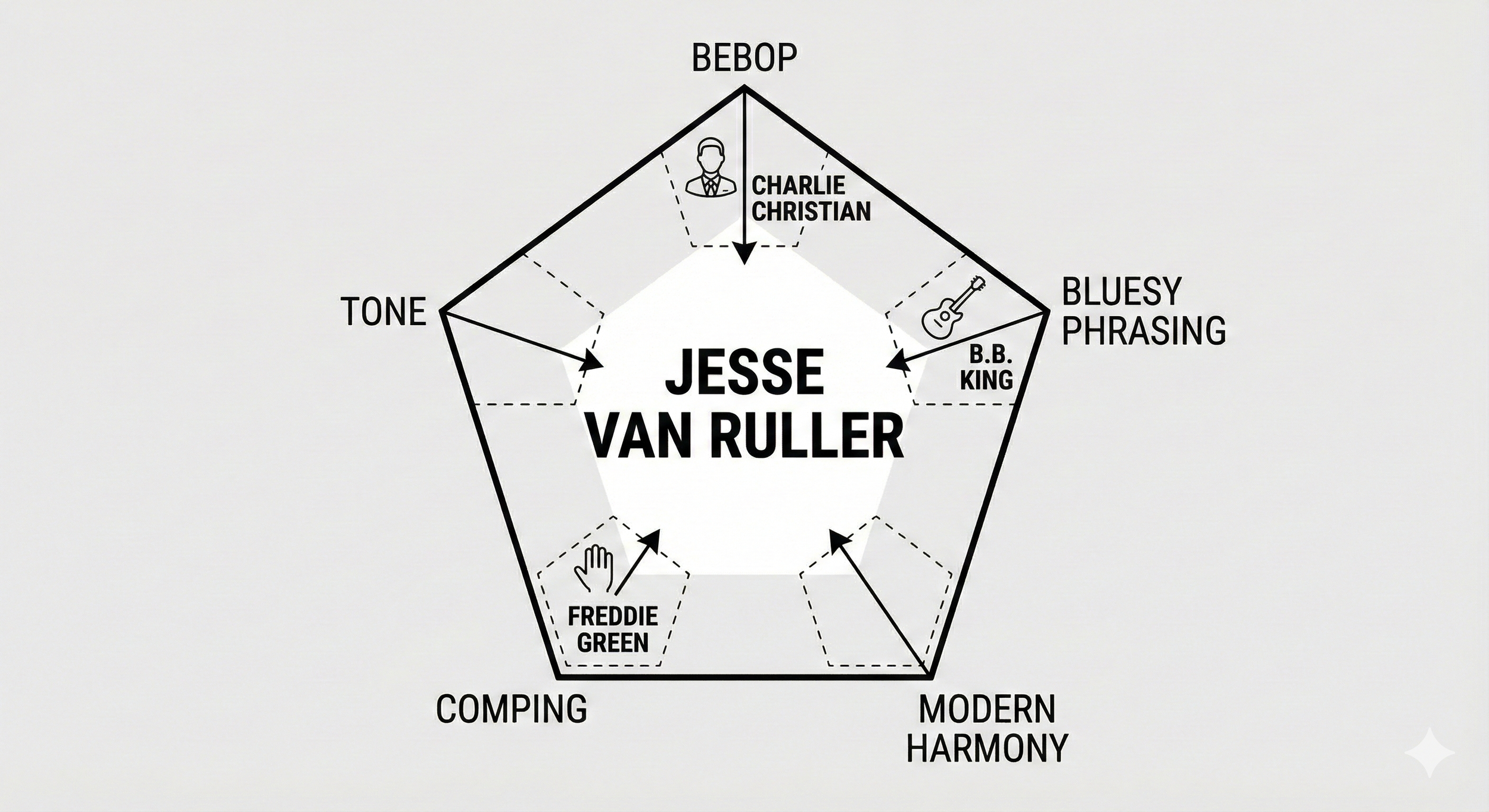
Analysis: Beyond the Specialist to the Synthesist
The conversation in the transcript (01:09:05) captures a fascinating point. It analyzes that Peter Bernstein is often classified in the "Grant Green lineage" precisely because he doesn't play "George Benson-style lines." His style is distinct and powerful, but deeply specialized in a particular domain. In contrast, Jesse van Ruller is depicted as a completely different type of artist. He can execute the flawless Benson-esque technique that won him the Monk Competition, yet when he performs in a duo with Peter Bernstein, he can produce phrasing that blends perfectly with Bernstein's aesthetic. In other albums, he even explores modern, effect-laden soundscapes.
To borrow the transcript's metaphor, he is an "all-weather" player whose 'pentagonal stat chart' from a video game is almost perfectly maxed out in all directions. This is on a different level than merely 'imitating' various styles. It is the ability to deeply understand the language and philosophy of each lineage and to access them freely according to one's own musical needs.
This "all-weather" quality has significant implications for the modern jazz guitarist. If the masters of the past were 'pioneers' who founded and deepened a specific school of thought, the masters of today are more like 'explorers' who navigate the vast inheritance left behind by them to draw new maps. This requires an even higher level of musicianship, demanding both a broader musical spectrum and a deeper historical understanding simultaneously.

Stylistic Fusion of Modern Jazz Guitarist
Conclusion: Draw Your Own Pentagon
This discussion is by no means an argument against deep specialization. On the contrary, it's about the next step that becomes possible only after one has established a core identity. As advanced players, we must ask ourselves: What is the shape of my musical 'pentagon'? Where are my strengths and weaknesses across bebop, blues, modern harmony, comping, and tone? While I dig deeper into my own lineage, how well can I understand and incorporate the languages of others? At the end of this reflection, you may find the path to becoming your own unique, 'all-weather' artist.
To analyze the masters in-depth and expand your own spectrum, find more insights at Bridge: Theory and Bridge: Sound.