
Can You Really Start Jazz Guitar Without Theory? The Secret of the Early Masters
Hello and welcome to the VoiceLid Jazz Guitar blog. One of the most frequent questions I receive from aspiring jazz guitarists is this: "Is it possible to play jazz without knowing any music theory or how to read sheet music, just like the early masters did?" It’s a thought that crosses the mind of anyone feeling overwhelmed by the mountain of theory ahead. The short answer is, "It's not impossible." However, this path comes with a crucial prerequisite, one that might be even more challenging than studying theory itself: the process of truly opening your ears.
If you’re wondering where the right starting point actually is, Building Blocks is designed to meet you exactly where you are — no prior theory required.
If you've felt this 'connect the scales' instinct before, see Why Connecting Scale Shapes Won't Help You Play Jazz Changes.
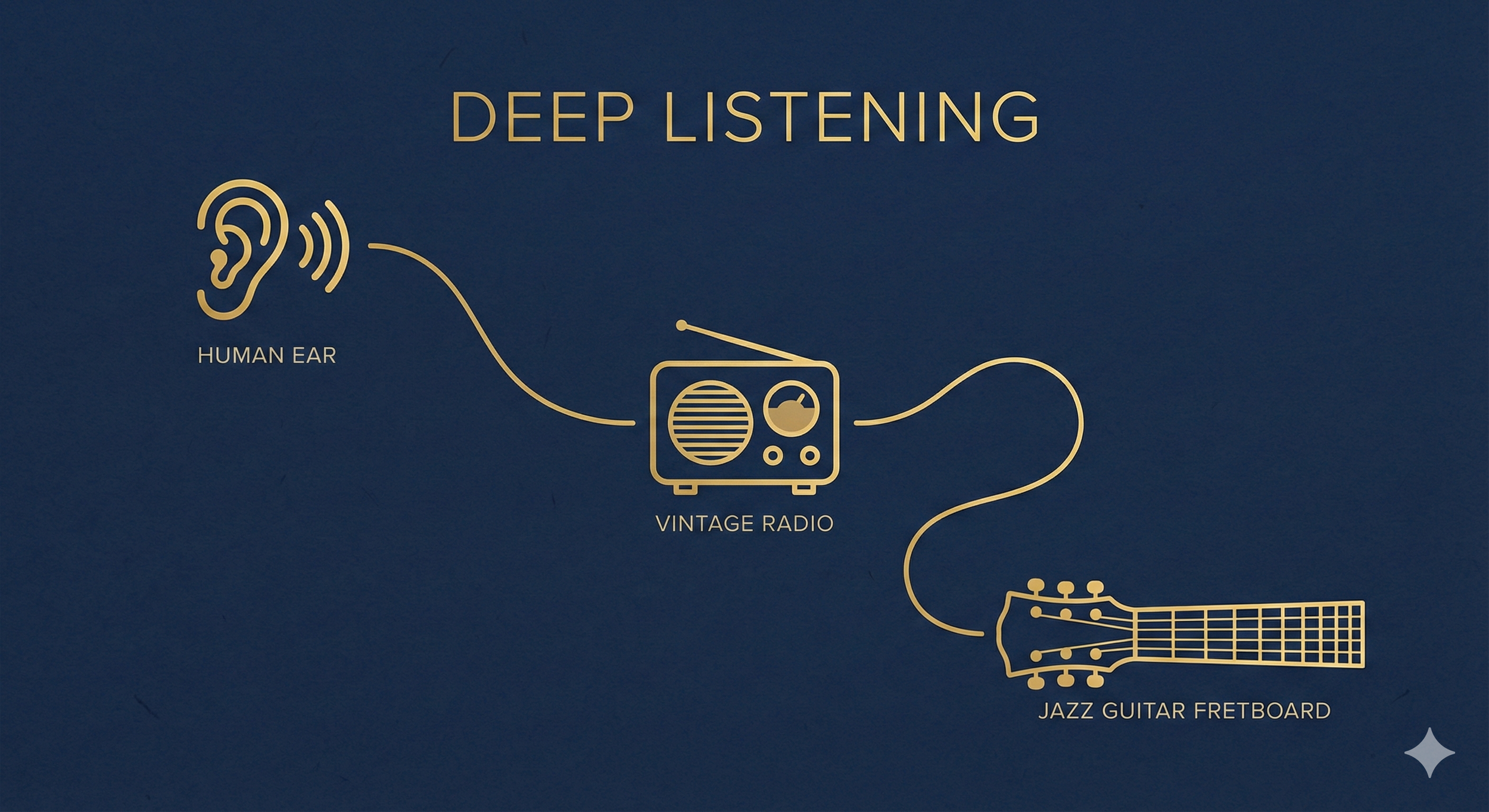
Learning Like a Child Early jazz musicians often lacked formal education. They were simply given an instrument. Their method of learning was beautifully organic: they would listen to music on the radio and then painstakingly find those same melodies and harmonies on their instruments. This process is identical to how a child learns a language. They don't start with grammar books; they learn by being constantly immersed in the language spoken by their parents, family, and community. The cornerstone of this approach is Deep Listening. This isn't about having music on in the background. It’s an active, focused process of listening to a single piece of music dozens, even hundreds, of times until every sound, nuance, and harmonic movement becomes a part of you. This path requires three deliberate steps:
1. Choose One Song and Listen Obsessively: Pick a standard you dream of playing. Find multiple versions by different artists and listen to them relentlessly—on your commute, before you sleep, whenever you can. Your goal is to internalize the song so deeply that it becomes second nature.
2. Sing the Melody (and the Solos): Before you even touch your guitar, you should be able to hum or sing the melody accurately. Try to mimic the phrasing and articulation of the vocalist or soloist. This connects the music in your head to your own physical expression.
3. Find the Notes on Your Fretboard: Now, with the melody etched in your mind, pick up your guitar. The final, and most critical, step is to hunt for those notes on the fretboard. This "fumbling" process is the essential bridge between your musical ear and your instrument. It’s what builds true musicianship from the ground up. The Modern Reality Check While this "ear-first" approach is pure and historically significant, let's be realistic. In today's world, it can demand far more time and patience than simply learning the fundamentals of theory. The hard truth is that learning basic concepts like chord tones, guide tones, and the foundational II-V-I progression can be a massive shortcut. It provides a framework—a map—that makes navigating the complexities of jazz harmony infinitely more efficient. The early masters created the map; we have the privilege of being able to study it.
Starting jazz without theory is like navigating the open ocean with only your ears as a compass. It’s a romantic and possible journey, but having a map (theory) will help you reach your destination faster and with more confidence. Here’s your assignment for today: Pick one of your favorite jazz standards and listen to it all day. Then, try to find the main melody on your guitar, one note at a time. The theory can wait. Start your jazz journey from a place of pure joy—the joy of listening. For a more structured path to learning jazz guitar improvisation and harmony, visit https://www.youtube.com/@voicelidjazzguitar for lessons and in-depth articles.