
The Physics of Jazz Tone: Pick Thickness and the Rest Stroke
The Elusive Quest for Jazz Tone
Welcome to VoiceLid Jazz Guitar. For beginners embarking on the journey of jazz guitar, the most immediate stumbling block is often not the complexity of harmonic theory, but the visceral quality of "Tone." You listen to the legends—Wes Montgomery , Jim Hall , George Benson—and you hear a sound that is warm, round, and enveloping. Yet, when you plug your own instrument into an amplifier, the result is frequently thin, brittle, and discouragingly "clicky."
Many novices immediately blame their gear, scouring the internet for vintage archtops or boutique tube amplifiers. However, 80% of that coveted sound originates not from the electronics, but from your right hand and the small piece of plastic it holds. Drawing from a deep-dive session between guitarists Choi June-won and Park Gap-yun, this post explores the fundamental physics of pick selection and the technique of the stroke.
If you’re still building your jazz foundation and want to understand how technique and tone connect to the music, Building Blocks is the right starting point.
The right-hand mechanics that make this tone possible are unpacked in The Anatomy of Thick Tone: Decoding the Right Hand of George Benson and Grant Green.
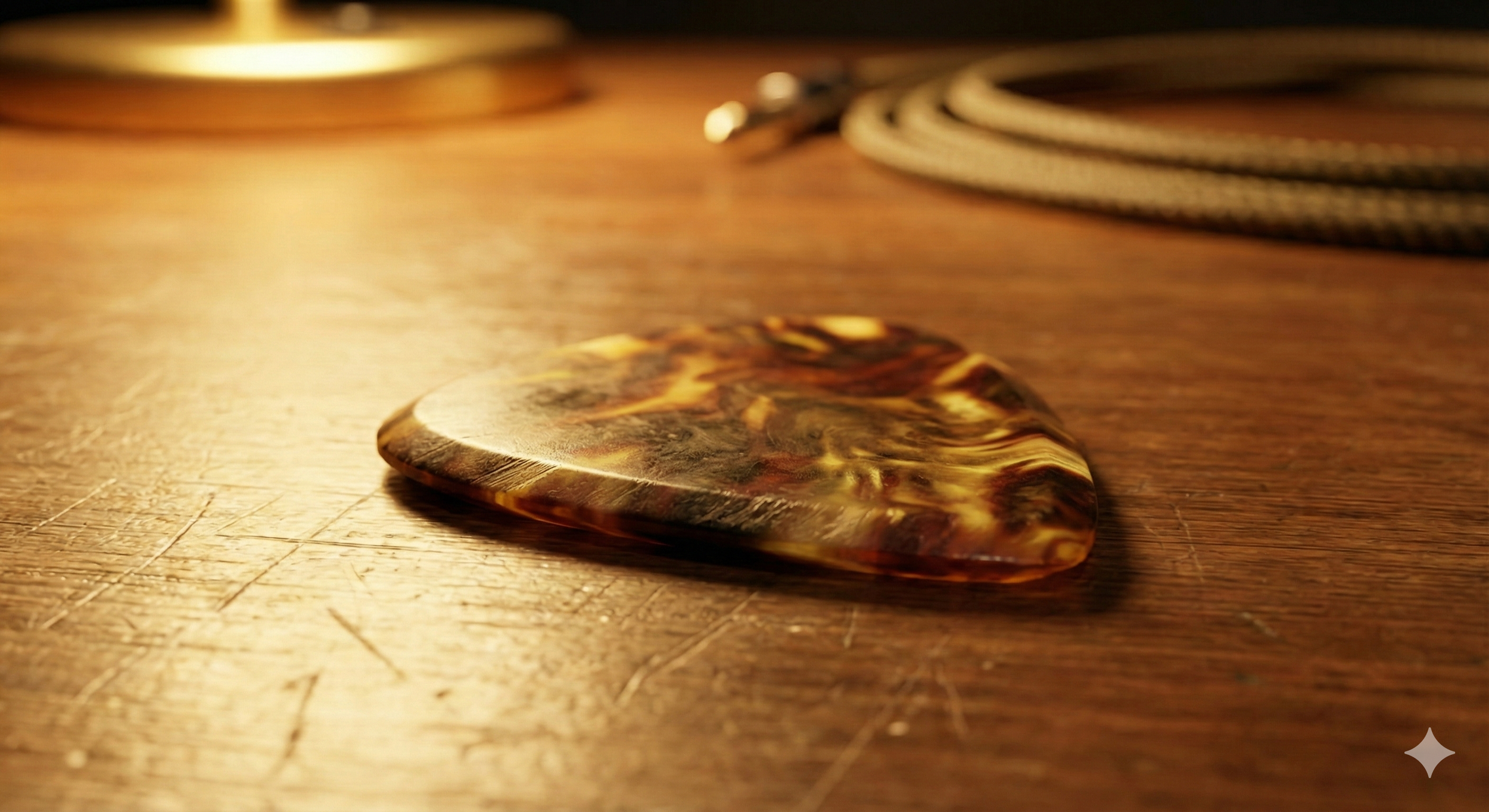
Mass vs. Velocity in Tone Production
The Argument for Thickness: Park Gap-yun’s Approach
In their discussion, guitarist Park Gap-yun revealed his preference for a heavy 1.5mm pick (typically the Pro Plec style). This is significantly thicker than the standard medium picks used in rock or pop. Why choose such a blunt instrument?
Physics dictates that a thin pick flexes upon contact with a string. This flexion generates high-frequency overtones—the "snap" or "click" sounds. While desirable for acoustic strumming, this works against the dark, warm aesthetic of jazz. A thick pick does not flex. It drives through the string with mass, naturally rolling off the treble frequencies and emphasizing the fundamental low-mids.
Choi June-won described Park’s resulting tone as "Impressionistic, reminiscent of Debussy or Ravel." If you seek a sound that creates a misty, soft, and atmospheric mood, switching to a heavy, round-tipped pick is the most effective and affordable upgrade you can make.
The Power of the Rest Stroke: Choi June-won’s Approach
Conversely, Choi utilizes a Fender Medium pick—surprisingly thin for a jazz context. Yet, his tone is anything but thin. He describes his sound as having the "masculine power and clarity of Chopin or Rachmaninoff." How does he achieve this sonic density with a lighter pick? The secret lies in the Rest Stroke.
Inspired by George Benson, the Rest Stroke is distinct from the "Free Stroke" most beginners use. Instead of plucking the string and lifting the pick into the air, the player pushes through the string until the pick comes to rest on the adjacent string below.
The Mechanism: This action forces the string to vibrate towards the body of the guitar, driving more energy into the top plate.
The Result: It creates a "fat" core to the note with reduced high-end splash and increased sustain. It turns the guitar into a percussion instrument, giving every note a piano-like attack.
Practical Steps for Beginners
Before you buy a new pedal, try refining your physical approach:
Experiment with Density: Purchase a variety of jazz picks ranging from 1.5mm to the extra-heavy 2.0mm. Notice how the "click" disappears and the "thud" appears.
Practice Gravity: When playing scales, force your pick to land on the next string. Feel the resistance. It requires more commitment than a standard stroke, but that weight is exactly what translates into "Tone."

Your Hands are the Equalizer
Tone is a choice. Whether you prefer the impressionistic softness of Ravel or the percussive clarity of Rachmaninoff, the control lies in your fingertips. Stop adjusting your amp knobs and start adjusting your touch.
For detailed video guides on right-hand mechanics and tone exercises, visit VoiceLidJazzGuitar.com.