The Legacy of Monk & Duke: Why Finding Your Own Voice Matters More Than Technique
The Professor's Question
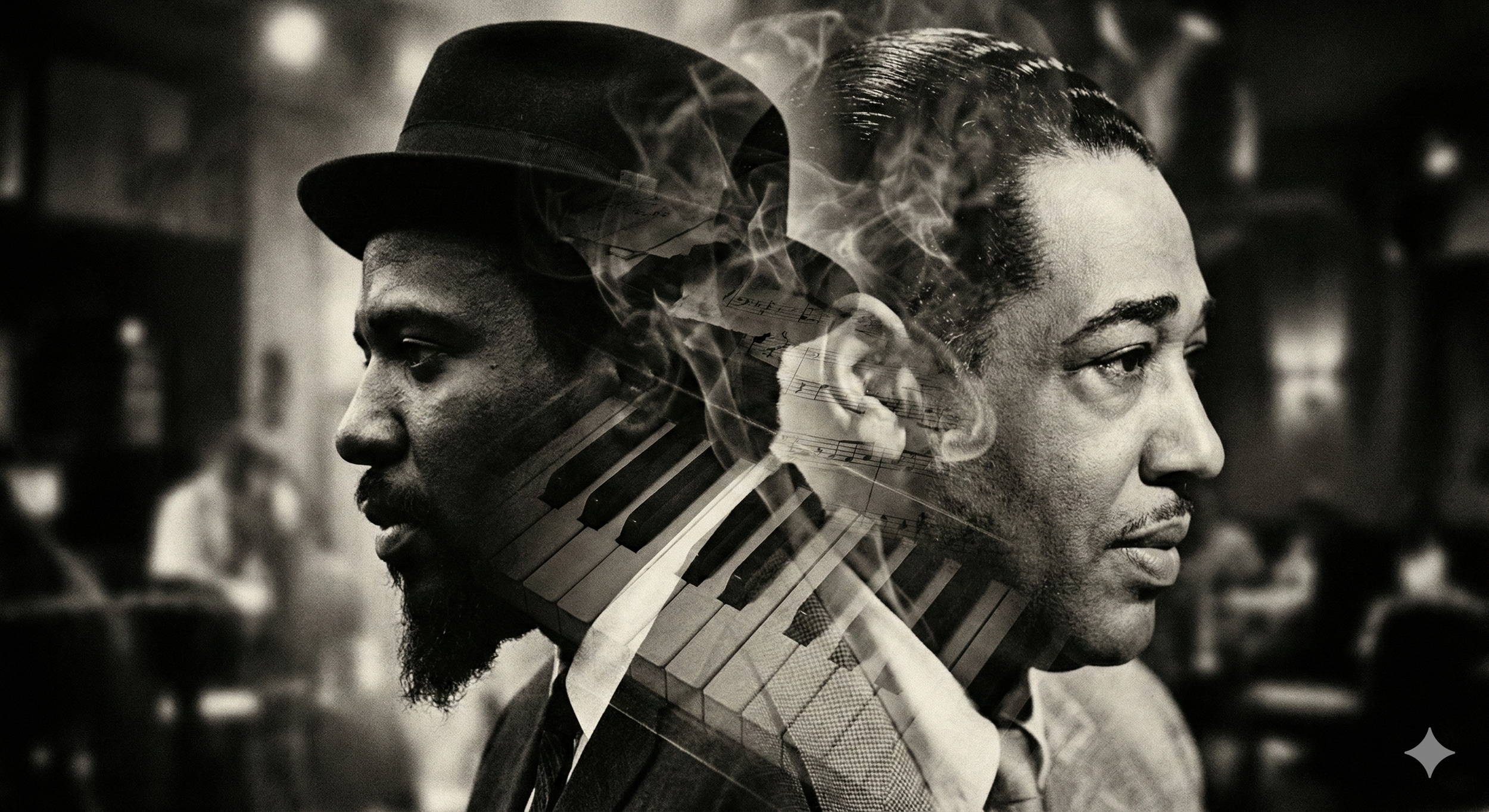
As we wind down the week, I want to share a philosophical reflection that shapes how I view jazz. Back when I was a student at Berklee, a professor posed a provocative question to the class: "Who is the single most important figure in jazz history?" Students shouted out names like Miles Davis or Charlie Parker. I was convinced it was Miles. But the professor’s answer surprised us: Duke Ellington. And standing right beside him in terms of harmonic impact was Thelonious Monk. This wasn't about who played the fastest or had the best tone. It was about who defined the identity of the music.
The Architect and The Individualist
Duke Ellington is the godfather because he took the raw, visceral emotion of the Blues and codified it into sophisticated Song Forms. He proved that jazz could be high art without losing its roots.
Then there is Thelonious Monk. In our live session, I discussed how Monk was famously misunderstood. Critics in his early days called his piano technique "crude" or "clumsy." They thought he lacked virtuosity. They were wrong. Monk wasn't playing "badly"; he was playing properly for his music. He intentionally developed a percussive, angular style to express his unique harmonic concepts—Whole Tone scales, Augmented chords, and jarring dissonances—that standard bebop technique couldn't capture.
I shared a story about a friend from my time in Michigan—a brilliant technical pianist. A professor asked him to play a specific Monk phrase. This virtuoso, who could play anything, stumbled. Why? Because Monk’s music requires a completely different physical and mental approach. Monk refused to compromise his sound to fit popular standards. He famously resisted playing other people's hits, insisting on his own compositions even when it cost him gigs. He chose Originality over popularity, and paradoxically, that is why he is immortal today.
If you want a structured way to apply this discipline, see How to Build a Jazz Guitar Practice Routine in 10-Minute Blocks.
The Weekend Reflection: Finding Your Voice
As students, it is easy to get obsessed with speed, clean picking, and complex scales. We treat music like a sport. But Monk and Duke teach us that Intent is more significant than Technique. Are you playing a scale because it fits the grid, or because you hear that sound?
True artistry isn't about being the fastest gun in the west; it's about having a voice that is unmistakably yours. Even if your technique is limited, if you play with conviction and personality, you are making art. If you just copy licks, you are essentially a typewriter.
If any of this resonates and you’re wondering where to start developing your own musical voice on the guitar, Building Blocks is the entry point.
Conclusion
This weekend, I invite you to turn off the metronome. Listen to Monk’s 'Round Midnight. Hear the spaces he leaves, the "wrong" notes he makes sound right. Ask yourself: "Am I expressing myself, or am I just practicing mechanics?" Play like you mean it. Let your personality shine through your instrument, warts and all. That is the spirit of jazz.