
Jazz Guitar Fundamentals: Tone Secrets & Shell Voicing Routine
Defining Your Jazz Identity
For beginners transitioning from rock or blues to jazz, the quest for the perfect jazz guitar tone can be elusive. Is it the guitar? The amp? The fingers? In my recent Q&A session, I broke down the specific elements that define my sound and the fundamental practice routine that lays the groundwork for improvisation. It starts with understanding your gear and mastering the "Shell Voicing" through the Circle of Fifths.
For a foundational look at guide tones and shell voicings, see Breaking Free from Scale Blocks: A Beginner's Guide to Shell Voicings.
The Anatomy of Tone
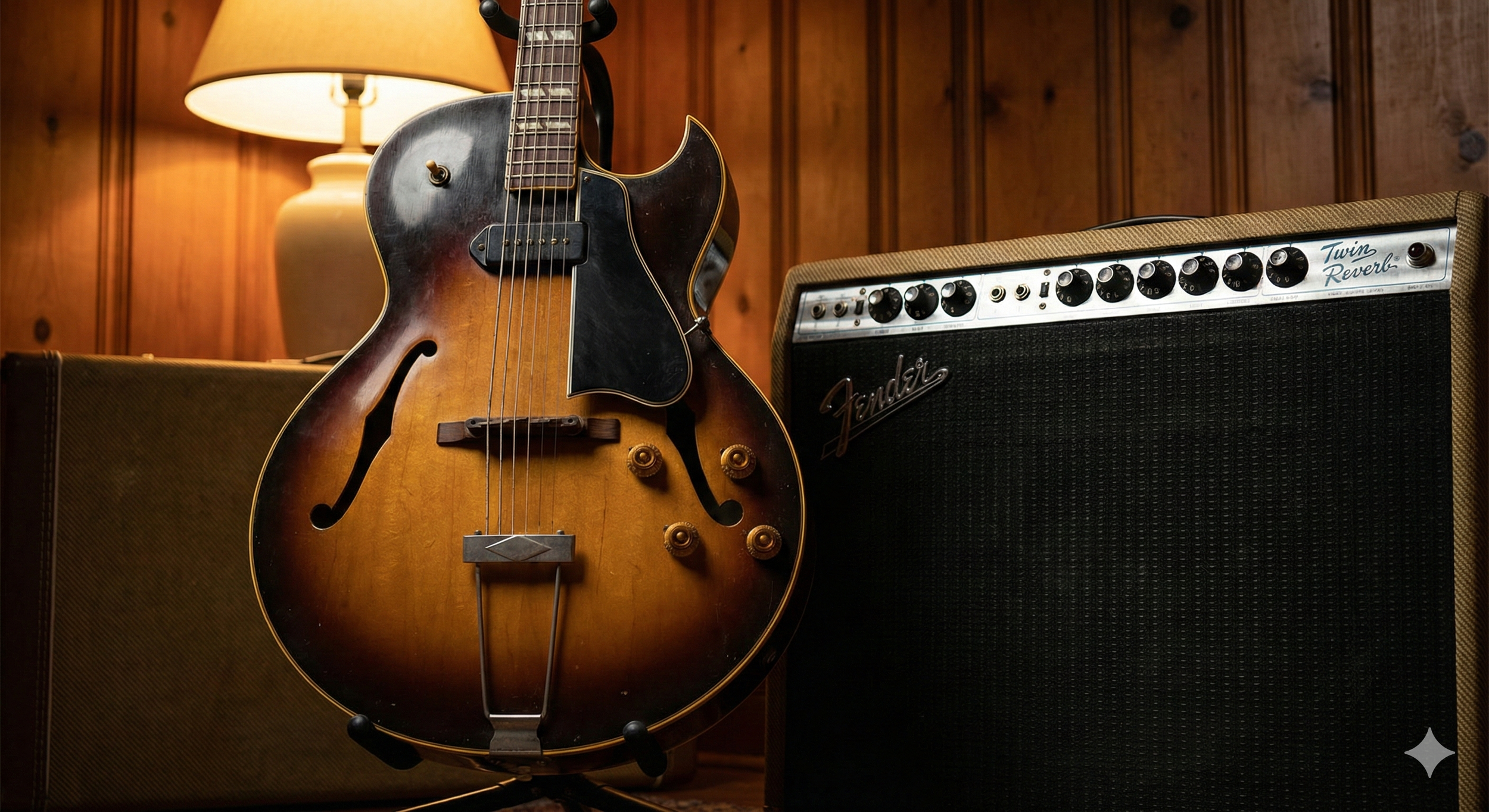
Tone is subjective, but understanding the variables allows you to find your voice. Personally, I prefer the sound of an Ebony fretboard (typically found on a Gibson L-5) over Rosewood (Gibson ES-175). Ebony offers a focused, clean clarity, avoiding the nasal "honk" often associated with Rosewood. However, the real secret lies in the strings and attack. I use heavy gauge flatwound strings (starting with .014 or .016 for the high E). Why so heavy? Because for years, I played exclusively with my thumb, like Wes Montgomery. Heavy strings respond better to the flesh of the thumb, creating a percussive "pop" sound that thin strings simply cannot replicate. Even when using a pick now, that heavy resistance is crucial for my dynamic control. For amplification, I lean towards tube amps like the Fender Twin Reverb rather than solid-state amps like Polytone. Here is a specific pro-tip for achieving a warm yet clear jazz tone: Set your amp’s treble to around 6-7, keep the bass and mids low (around 2-3), but—crucially—roll your guitar’s volume knob down to about 8.5. Then, compensating by turning up the amp volume creates a sweetened, compressed clean tone that is rich in harmonics but free of harsh distortion.
The Golden Practice Routine: Shell Voicings & The Circle of Fifths
Once your tone is set, what should you practice? Ignore complex scales for a moment. The foundation lies in Chord Tones and Shell Voicings (playing only the Root, 3rd, and 7th). Do not practice chords statically. Jazz is music of movement. You must practice navigating the fretboard using the Circle of Fifths.
For a complete map of how shell voicings and guide tones function across chord types, the Bridge Theory Reference page lays it out clearly.
• The Sequence: I → IV → VII → III → VI → II → V → I
• In C Major: C → F → B → E → A → D → G → C
By moving your shell voicings through this cycle within a single key, you visualize the functional harmony across the entire neck. This is the roadmap used by legends like George Benson to connect lines seamlessly.
Tone comes from the combination of material (strings, wood) and technique (thumb/pick), but musicality comes from understanding harmonic movement. Master the Circle of Fifths with shell voicings, and you will build a solid foundation for everything that comes next. For more detailed lessons, visit VoiceLidJazzGuitar.com.