
Beyond Theory: Target Notes and Visualizing Sound Colo
Don't Let Theory Paralyze You
As advanced jazz players, we often fall into the trap of over-intellectualizing our craft. We obsess over the "Lydian Chromatic Concept," "Negative Harmony," or esoteric hexatonic scales. There is a certain intellectual satisfaction in understanding these structures. However, on stage, in the heat of improvisation, if you are engaging in mental calculus instead of listening and reacting, that knowledge becomes a heavy burden rather than a tool.
Guitarist Choi June-won shared a pivotal story from his master’s audition at Indiana University that challenges this mindset directly. When faced with complex requests from masters, do they calculate intervals, or do they simply hear the sound? In this post, we delve into the Target Note strategy and the importance of Sound Visualization over theoretical rigidity.
If you’re still building the fretboard framework that makes target note thinking possible, Building Blocks is the place to start.
If you want a structured way to apply this discipline, see How to Build a Jazz Guitar Practice Routine in 10-Minute Blocks.

The Power of One Note & The "Label" Trap
The Hal Crook Method: Target Notes
Legendary Berklee educator Hal Crook had a method to cure students of predictable "scale running." He forced them to choose one single target note for a chord and build everything around it.
Let’s look at a practical example. Imagine a static G7 vamp.
The Technical Player: Runs the Mixolydian or Diminished scale up and down. Correct, but boring.
The Musical Player: Targets simply the #5 (D#). Every phrase is an approach to this specific tension. Initially, it creates a strong dissonance, but the musicality lies in how you resolve that tension into the 3rd or 9th of the tonic. You aren't playing a scale; you are playing a specific mood.
Theory is Just a Label for Sound
During the live session, the duo fielded questions about George Russell’s "Lydian Chromatic Concept." Their conclusion was liberating: Whether you analyze a sound as a mode of Melodic Minor, an Altered Scale, or Lydian Augmented, strictly speaking, doesn't matter. It is simply "a fight for color within the 12 chromatic notes."
Choi’s audition story illustrates this perfectly. An examiner asked him to play "A-Flat Lydian b7." Choi stumbled over the mental calculation of the scale degrees, panicking slightly. However, he intuitively played the sound associated with it—the floaty, mystical quality of the mode. The examiner stopped him and said:
"We need players who can produce that sound, not people who just memorize scale names."
Herbie Hancock’s Intuition
Masters like Herbie Hancock or Wayne Shorter might see a chord symbol but play something entirely different based on the sonic color they want to project at that moment. They treat harmony as a painter treats a palette, not as a mathematician treats a formula. To achieve this level of freedom, you need to verify your "Muscle Memory"—can your fingers find the #11 instantly without your brain counting intervals?
Advanced Practice Routine: Constrained Freedom
The "One Note" Challenge: Play through a tune like Stella by Starlight. On every V7 chord, force yourself to hit the b13 (or any specific altered tone). Make it musical, not mechanical. Learn how it feels under your fingers.
Chromatic Approaches: Don't just jump to the target note. Enclose it. Slide into it. Use chromaticism to highlight that target.
Visualizing Color: Stop seeing scale patterns. Start seeing the fretboard as zones of "Brightness" (Natural Tensions 9, 13) and "Darkness" (Altered Tensions b9, #5).
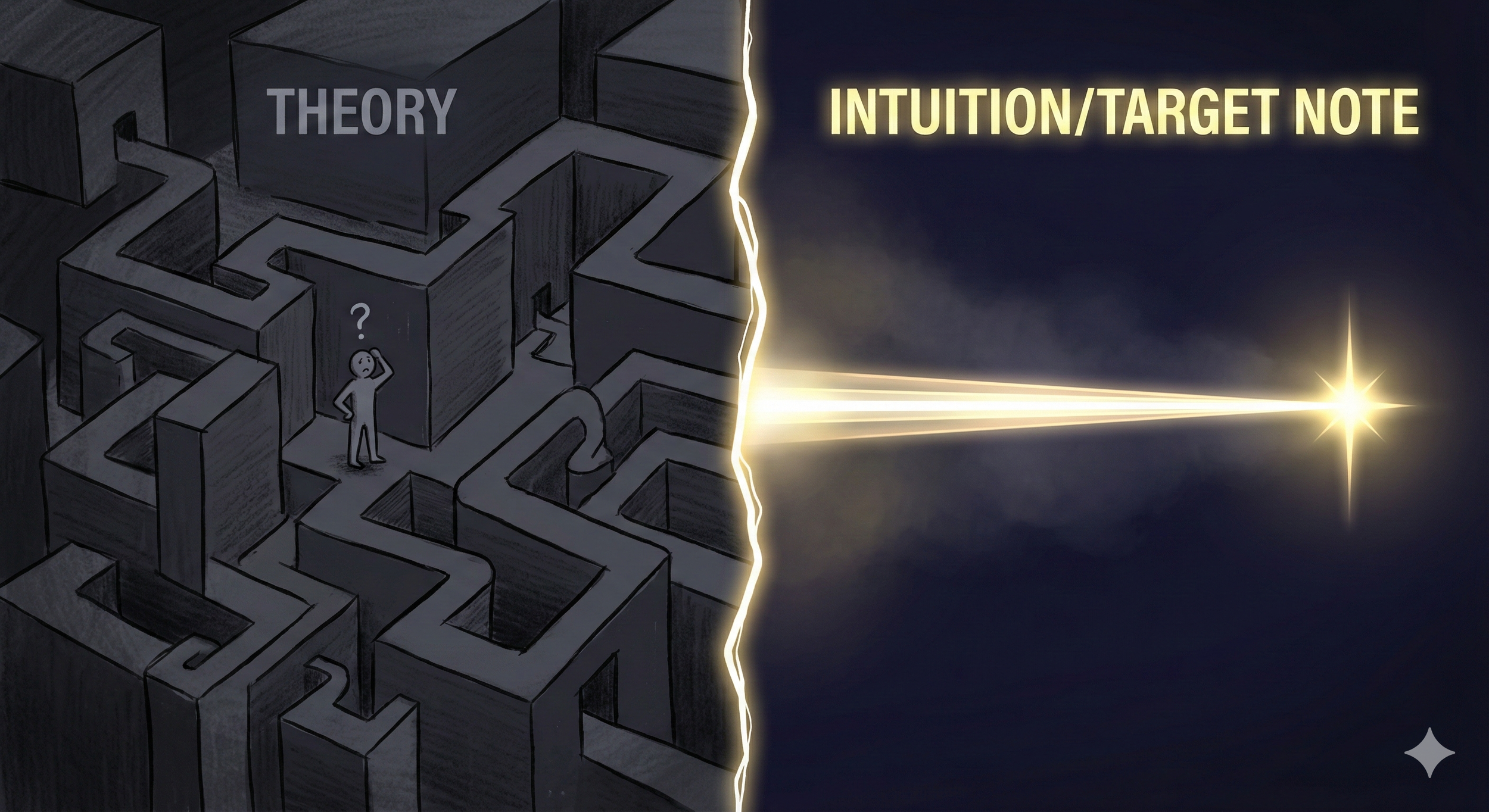
Your Ears Must Be Faster Than Your Brain
Complex theory is merely a map drawn after the territory was discovered. The goal isn't to memorize every detail of the map, but to know the terrain so well that you can walk it in the dark. Trust your ears and your muscle memory. Move beyond the scales and start hunting for target notes.
For deep dives into modern harmonic concepts and improvisation strategies, explore the advanced curriculum at VoiceLidJazzGuitar.com.