
Decoding Rhythm Changes: Raw Blues Instinct and the Genius of Jim Hall
Escaping the Math Equation for Raw Energy
As a jazz guitarist ascends into the advanced realms of study, they inevitably wander deep into the dense, often exhausting forest of advanced harmony. You are taught to weaponize complex theories: Altered dominant scales, continuous Tri-tone substitutions, and sprawling Upper Structure Triads. Yet, at the absolute pinnacle of mastery, you realize that sometimes the most primitive, raw sound is the most sophisticated and devastatingly effective solution.
A textbook example of this phenomenon is the deployment of the simple Blues or Pentatonic Scale over the notoriously brutal, fast-paced harmonic obstacle course known as "Rhythm Changes." Analyze the live recordings of guitar giants like George Benson or modern virtuosos like Dan Wilson. While the rhythm section is furiously navigating complex I-VI-II-V turnarounds, they aren't micro-managing chords; they unleash a torrent of relentless, feral blues lines as if they were playing a one-chord vamp.
The Building Blocks course gives you the foundation you need before diving into Rhythm Changes.

Benson’s Fire vs. Jim Hall’s Architectural Space
Executing the Blues scale at 250 BPM over Rhythm Changes is not about asking, "Is this note theoretically correct for a C7b9?" As George Benson demonstrated for decades, it is a dominant act of imposing a 'bluesy conviction' over the entire structure. Rather than timidly tip-toeing from target note to target note, these masters commandeer the narrative through sheer rhythmic swagger and raw emotional power. If you transcribe Dan Wilson’s solo over Oleo, you will uncover wildly aggressive connective tissues and syncopations that completely defy standard Berklee harmony textbooks.
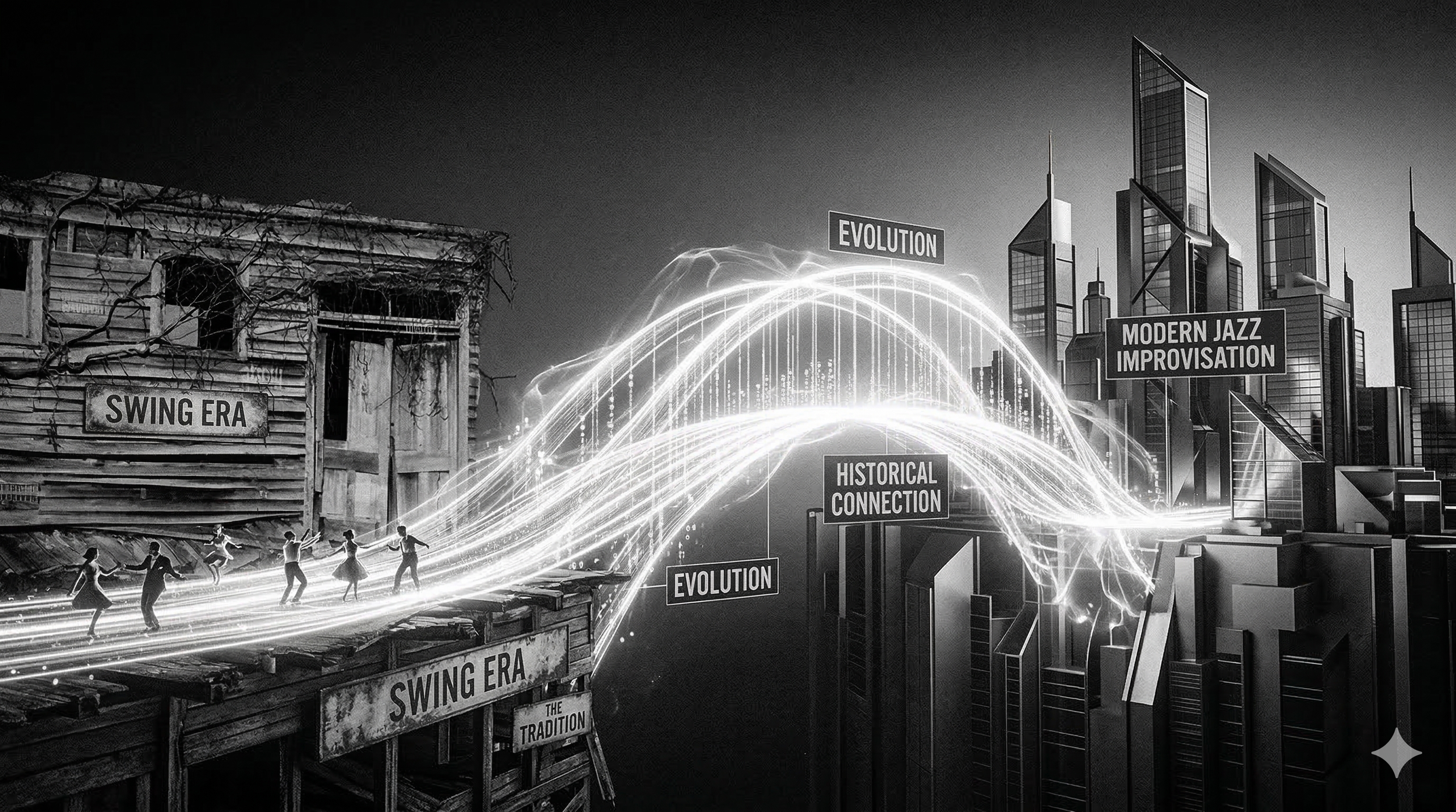
However, being a truly advanced player requires an opposing skill: the intellectual capacity to cool the room down. The ultimate bridge between the fiery tradition of jazz guitar and the highly intellectual, spacious modern era was built by none other than Jim Hall. If Wes Montgomery and Grant Green represented the muscular apex of traditional hard bop, Jim Hall was the "Missing Link" who hollowed out the harmony, creating the spacious framework that allowed modern players like Julian Lage and Gilad Hekselman to exist.
This genius is most terrifyingly evident on tenor giant Sonny Rollins’ landmark album, The Bridge. Operating in a piano-less quartet (Saxophone, Guitar, Bass, Drums), Hall possessed an ocean of harmonic space. Instead of monopolizing that space with dense chords, he deliberately leaves it empty. Rather than suffocating Rollins, he hovers. He utilizes sparse clusters and unpredictable, rhythmic jabs to constantly converse with the drums and bass. It is here that the concept of the modern guitarist—transparent, highly reactive, and harmonically ambiguous—was firmly established.
Equip Yourself with Fire and Ice
Graduating to an advanced level means multiplying your choices. Do you possess the raw, unbridled firepower to blast through a blistering Rhythm Changes with the unwavering blues conviction of George Benson? Simultaneously, do you have the restraint and spatial awareness of Jim Hall to completely alter the emotional atmosphere of a stage using only two perfectly placed notes? Do not simply obsess over playing fast; obsess over the historical intent behind the notes. The hallmark of a true master is the duality of wielding both fire and space.
Explore deep harmonic analysis, advanced comping concepts, and transcribe the masters with us at VoiceLidJazzGuitar YouTube Channel.
더 배우고 싶다면:
🎸 이 영상에서 실제 연주로 확인: How Wes Montgomery Plays ii–V: The Hidden V7 Side of the Wes Line
📖 체계적으로 배우고 싶다면: Building Blocks — 무료 2시간 레슨