
Why Does Your Own Playing Sound Stale to You? You’re Its Most Frequent Listener
Almost every jazz player dislikes their own playing, and the reason is arithmetic: you hear yourself more than anyone else does. Here is what actually moves you out of a slump.
Stop Being Popular? It Didn’t Die — It Stopped Being PopWhy Did Jazz
Jazz was America's pop music and its Cold War export. Then studio technology, Miles Davis, and the teenage record market moved pop elsewhere. Jazz didn't die — it moved to the same track as classical.
What Makes Jacob Collier a Genius? His Ear — and That's the Lesson
Jacob Collier's genius isn't the 200-track loops — it's an ear that hears between the twelve notes and a voice that can sing what it hears. The lesson for jazz guitarists: the ear leads, the hands follow.
Why Did Wes Montgomery Say No to John Coltrane?
John Coltrane really did invite Wes Montgomery to join his band, and Wes really did decline — saying, with typical humility, that he had nothing to contribute. The full story touches McCoy Tyner's account, the guitar's strange position in jazz, and why the sounds Coltrane's band chased were already living inside Wes's lines.
Is Jazz Theory Only for Jazz? I Transcribed a Pop Ballad and Found All of It
Every composer already uses voice leading — they just don't call it that. Transcribing a pop ballad revealed the same 3rd-targeting melody and passing 7ths that jazz musicians spend years learning. The theory isn't a jazz dialect; it's the grammar underneath.
The ‘Big Ears’ Secret: How Jazz Guitar Masters Really Learned to Play
The real secret to playing jazz guitar like the masters isn't a scale system — it's the ear. George Benson learned tunes in one listen; Wes Montgomery memorized big-band parts without reading. Here's how 'big ears' are built.
GuitarYour Sound Is Inherited: A Weekend Reflection on Lineage in JazZ
Your sound on jazz guitar isn't invented from nothing — it's inherited from the teachers and heroes you study, then quietly personalized. A weekend reflection on lineage, the thumb, and the strings that carry someone else's influence.

You’ll Sound Like Yourself Anyway: Why Copying the Masters Won’t Erase Your Voice
Copying Wes, Benson, and Bernstein note for note won't turn you into a clone. The way you choose, phrase, and resolve those ideas is unavoidably yours — your own voice emerges through imitation, not despite it.
Jazz Guitar Practice Tips: Why Drilling One Tune Will Stop Your Growth
Most serious jazz guitar students hit the same invisible wall: they have one or two tunes they can play deeply, and everything else feels shallow. The reason is not lack of practice. It is the wrong shape of practice — and a borrowed metaphor from a Japanese comic book might be the clearest way to explain why.
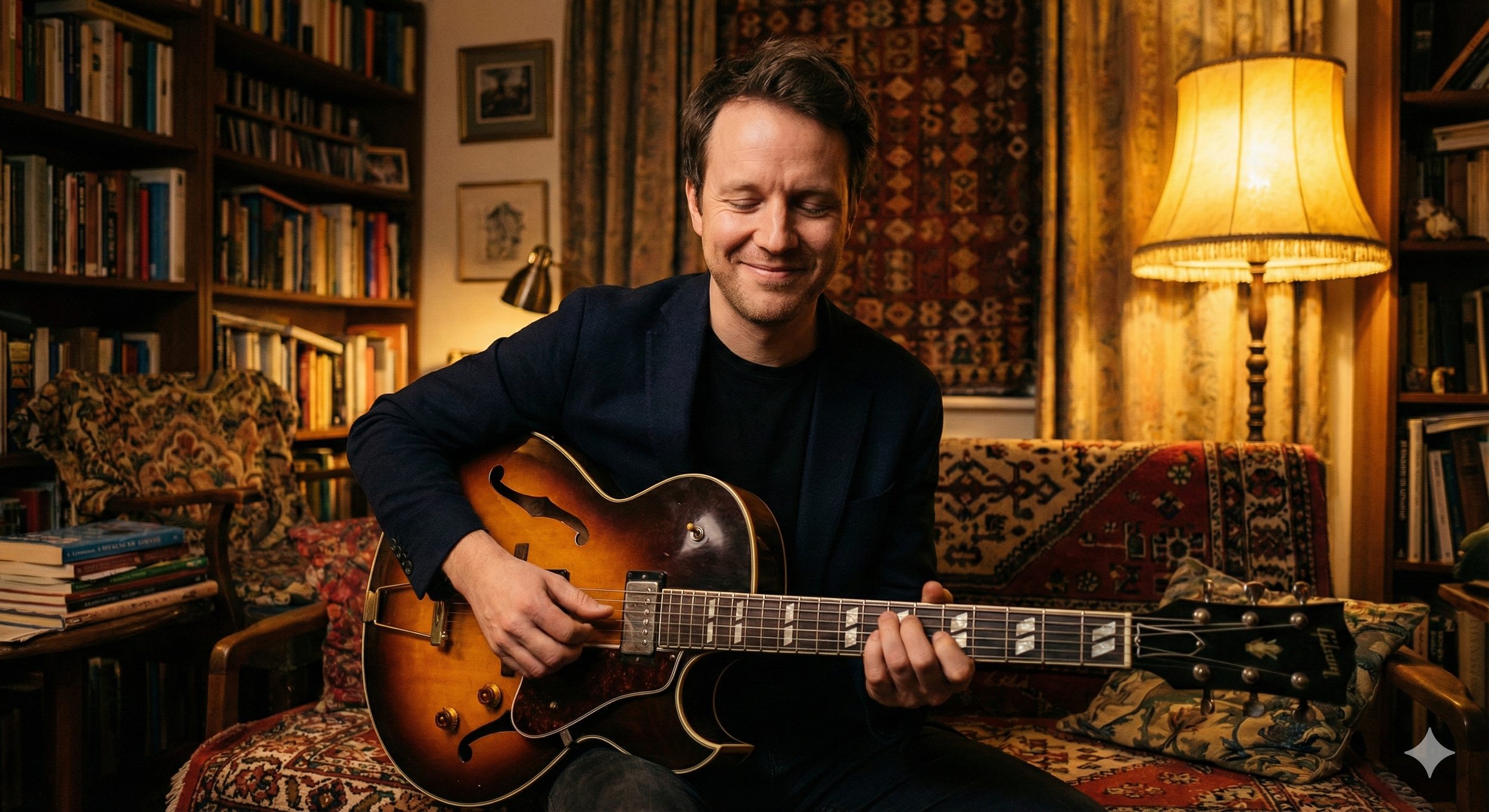
Stop 'Practicing' and Start 'Playing': The Most Important Mindset Shift for Jazz Guitar Growth
Many beginners fall into the trap of practicing drills endlessly—scales, chromatic exercises, arpeggios—without ever truly playing music. This article reframes your mindset: your practice room is not a gym, it’s a stage. Learn why playing full songs, even imperfectly, is the fastest and most joyful path to becoming a real musician.