
Mastering Comping: Abandoning Flash for the Art of Space
Why Your Bandmates Might Not Like Your Comping
As guitarists transition from the bedroom to the bandstand, the feedback they receive can be confusing. Instead of praise for your complex chord knowledge, you might hear pleas to "turn down" or "play less." You’ve practiced your drop-2 voicings and altered tensions diligently, so why does the band sound muddy and chaotic when you play?
The harsh reality is that the guitar occupies the crowded midrange frequencies. We fight for sonic space with the piano, the snare drum, and the vocalist. Ill-considered playing doesn't add richness; it adds clutter. In this post, inspired by the interplay analysis from Choi Jun-won and Park Ga-bin, we explore the art of Comping—specifically, the discipline of knowing when to play and, more crucially, when to remain silent.
The Bridge Theory Reference gives you a complete map of shell voicings and guide tones — the exact vocabulary that makes sparse, spacious comping work.
Shell Voicings and Contextual Awareness
The Art of Saving the Highs
A vital "pro tip" emerged from the session: Park Ga-bin mentioned he consciously avoids the 1st and 2nd strings during the early stages of a tune. "I save the high strings for the build-up," he noted.
Structurally, the 1st (E) and 2nd (B) strings operate in the same frequency range as the soloist’s melody. If you play thick, six-string chords early in the song, you are essentially shouting over the soloist.
Instead, embrace Shell Voicings (typically Root, 3rd, and 7th on the lower strings). By restricting yourself to the lower register (strings 4, 5, 6), you provide harmonic support without sonic competition. Keep those high strings in your pocket as a "secret weapon" to deploy only when the energy of the song peaks.
Context is King: Duo vs. Full Band
Your strategy must change like a chameleon depending on the instrumentation around you.
The Guitar Duo (No Bass/Drums):
Your Role: You are the entire rhythm section. You must include the Root in your voicings to ground the harmony.
Interplay: Passive playing kills a duo. Choi emphasizes active "Reaction." You need to be rhythmic, percussive, and responsive. Fill the empty spaces. Be the drums.
The Full Band (With Piano/Bass):
Your Role: Here, playing like a duo guitarist causes a 'war.' The bassist has the low end; the pianist has the rich harmony.
Strategy: Be invisible. Often, playing just the Guide Tones (3rd and 7th) is enough. Or, employ the "Freddie Green" style—muted, percussive strumming ("chank-chank") that adds rhythm rather than harmonic density. Park advises extreme caution here: "With a piano, even shell voicings can be too much. Listen first, play second."
Practical Practice Routine
The Constraint Exercise: Take a standard like Blue Bossa. Play through it using only 3-note shell voicings on the lower strings. Visualize the 1st and 2nd strings as "lava"—do not touch them.
Rhythmic Space: Instead of strumming on every beat, try to play only in the gaps. Let a whole bar go by with silence. Feel the power of that silence.
Comping is a Conversation
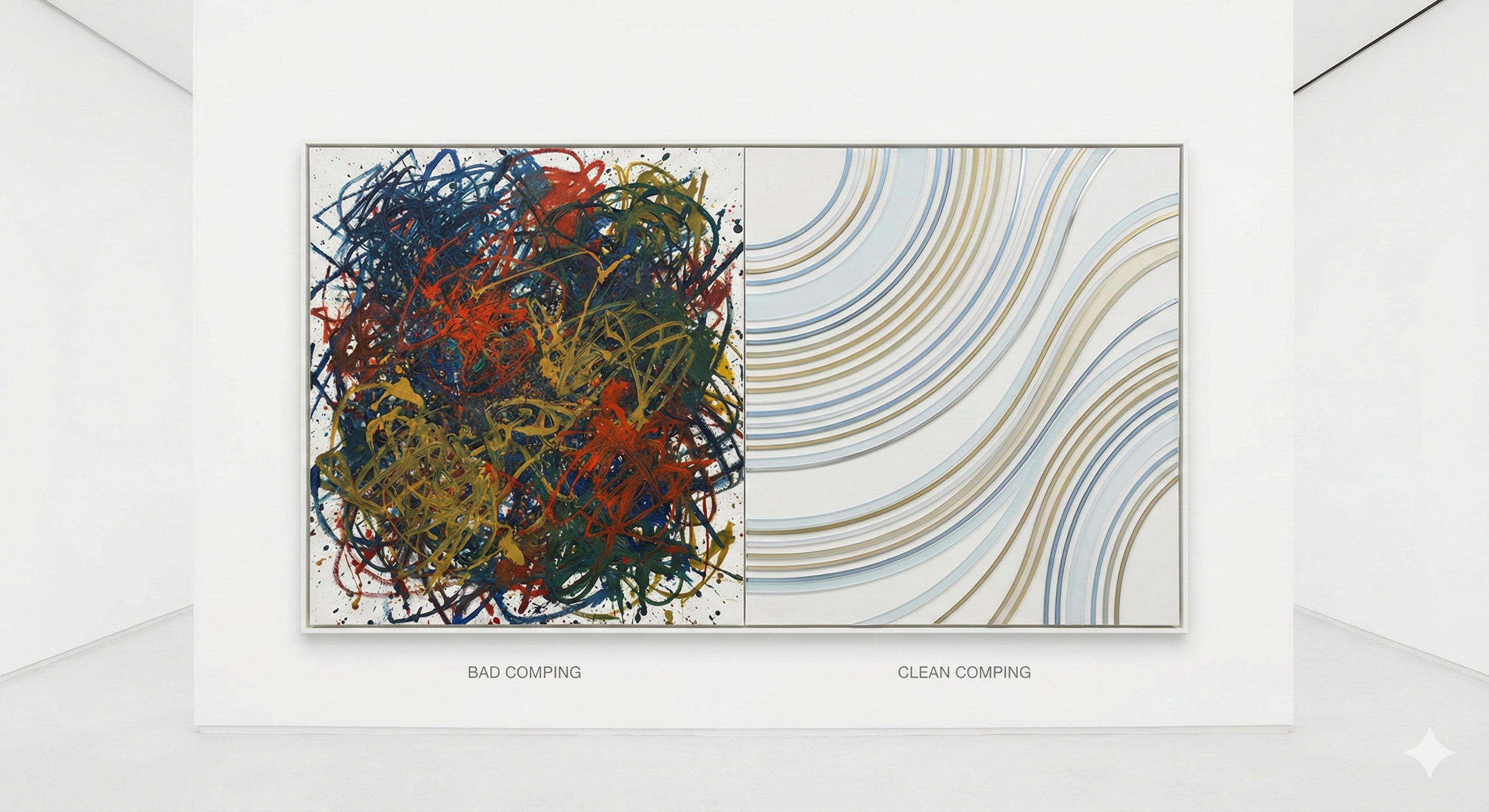
The term "Comping" comes from Accompanying and Complimenting. It is not an opportunity to show off your chord dictionary. It is an act of service to the soloist. Mastering the art of space and frequency management is what separates the amateur from the professional.
For comprehensive charts on voicings and situational rhythm patterns, check out the resources at VoiceLidJazzGuitar.com.