
Stop Memorizing Scale Blocks: The Linear & Diagonal Approach to the Fretboard
The "Multiplication Trap" of Scale Blocks
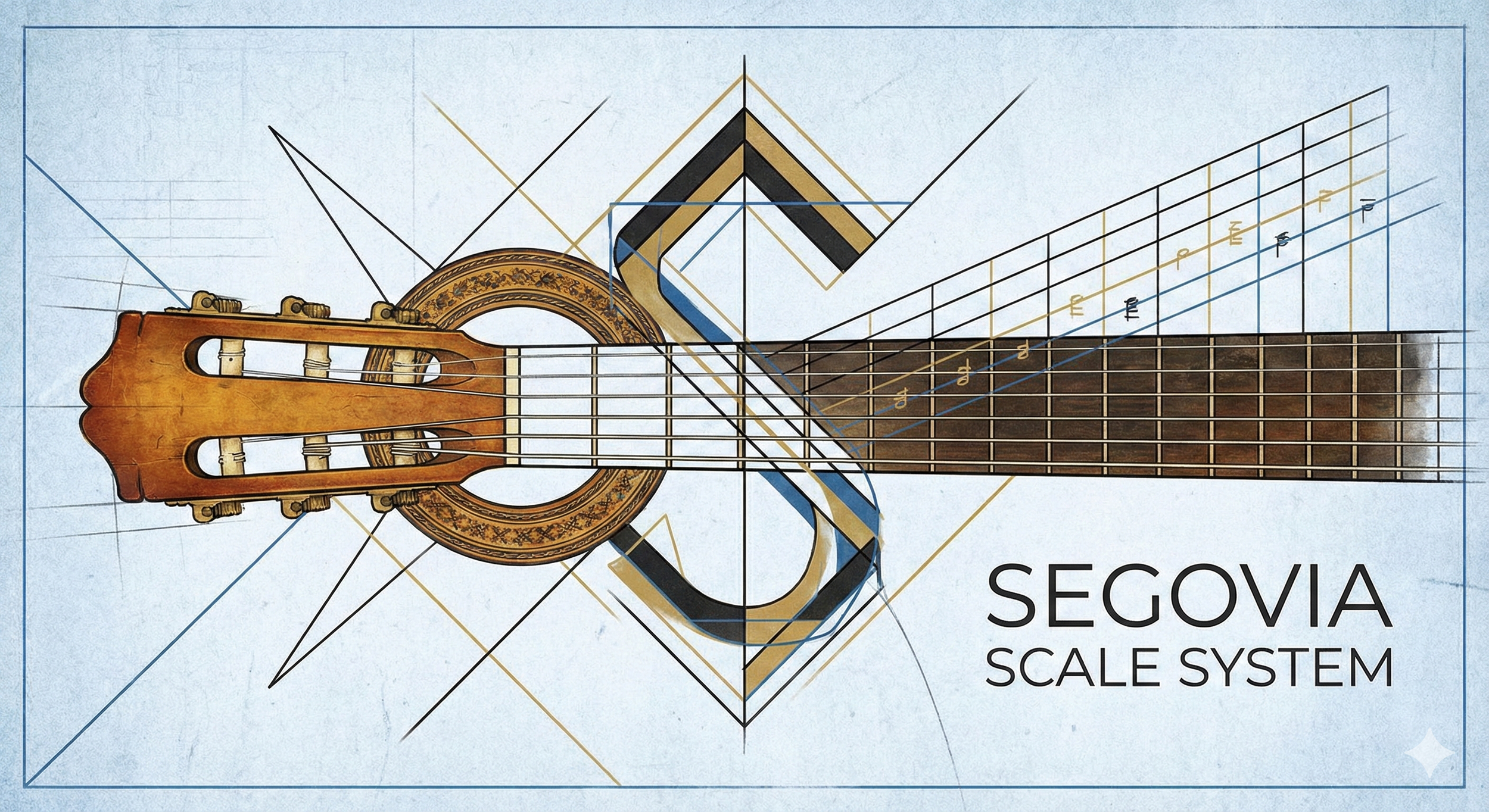
If you’ve ever taken a jazz guitar lesson or opened a method book, you’ve likely encountered the infamous "CAGED system" or the concept of "scale blocks." You are taught to memorize a box pattern starting on the 6th string, another on the 5th, and so on. While this creates a sense of order, it often leads students into what I call the "Multiplication Trap." Let’s do the math. To master just the C Major scale using blocks, you need to memorize roughly 5 to 7 patterns. But jazz involves 7 diatonic modes. That’s 35 patterns. Then multiply that by 12 keys. We are now at 420 patterns. Add in Melodic Minor, Harmonic Minor, and Harmonic Major scales, and suddenly you are tasked with memorizing thousands of fingerings. This approach is excellent for teachers who want to fill lesson time easily ("Memorize these three pages by next week"), but it is detrimental to the student who wants to actually make music. When you listen to legends like Wes Montgomery or Grant Green, they don’t sound like they are trapped in a vertical box. Their lines flow linearly and diagonally across the fretboard. Today, I want to share a method I learned from my mentor Richie Hart at Berklee, which is rooted in the pedagogical approach of the classical guitar maestro Andrés Segovia. This is the 2-Octave Linear Scale Form.
The 1-1-2-4 Fingering Concept
The problem with block scales is that when you move to the next octave, the fingering shape changes completely usually due to the B-string tuning shift. This forces your brain to process a new set of data mid-phrase. The linear approach eliminates this latency. Let’s stick to C Major. Start on the 5th string at the 3rd fret (C). Instead of staying in one position, use the fingering sequence: 1 (Index) - 1 (Index) - 2 (Middle) - 4 (Pinky). You play C, then shift smoothly with your index finger to D, then play E and F. Now, move to the next string and repeat the exact same logic. By doing this, you naturally shift positions up the neck, crossing strings and covering two full octaves without changing your mechanical thought process. This diagonal movement allows you to traverse from the lower frets to the higher registers in a single, fluid motion. This is exactly how classical guitarists navigate the instrument—they view the fretboard as a continuous path, not a segmented grid.
If you want to go further with the diagonal system and really map it across the fretboard, Fundamental 1: Wes Diagonal System gives you the complete framework.
Efficiency Creates Musicality
The beauty of this system is its universality. Once you master this one form for the Major scale, you automatically master the modes. Want to play G Mixolydian? Use the exact same fingering shape, just start on G. Want E Phrygian? Start on E. The mechanics remain constant; only the tonal center changes. During my time at Berklee, while my peers were stressing over hundreds of block diagrams for final exams, I mastered my technical requirements in minutes using this method. This efficiency gave me the precious time to focus on what truly matters: transcription, rhythm, and repertoire mastery.
The full framework behind this is the Functional Diagonal Approach.
Play Lines, Not Boxes
Jazz improvisation is about freedom, but you cannot be free if your mind is cluttered with grid coordinates. I encourage you to pick up your guitar right now and try this diagonal approach. It might feel strange to shift your hand position so frequently at first, but once you internalize the 1-1-2-4 logic, the entire neck will open up to you. Stop calculating blocks. Start hearing lines. For detailed diagrams and a video walkthrough of this Segovia-inspired method, please visit VoiceLidJazzGuitar.com.