
The blues has a blueprint.
Most players were only ever handed the decoration.
Serious inquiry only — enrollment opens after a required 30-minute trial session.
From the video that brought you here:
Berklee Scholars Find Giant Steps Easier Than the Blues — Why?
This video makes one argument. Blues Print is that argument, organized as a curriculum.
Scales and licks sit on the surface. Underneath every solo you actually admire is structure — how the changes move, and why.
Blues Print is that structure: drawn out, read from the masters' own recordings, and made playable.
DOES ANY OF THIS SOUND LIKE YOU?
None of these are talent problems. They're missing pieces of a blueprint — the materials, the route, the finish — that nobody ever drew out for you. If three or more make you nod, that's exactly what Blues Print rebuilds, one piece at a time: here's the symptom, here's the cause, here's what to change.
The materials were never cut — the sound itself won't come out
You stay trapped inside the pentatonic and can't get out. Hitting the major 3rd plainly sounds corny — there's no blues nuance. You think "blues = minor pentatonic," so a real blues sound never appears.
There's no route through the changes — you can't follow the chords
The chord moves from I to IV but your solo sounds the same. You freeze on the dominants (V7, VI7) and don't know what to play. You don't target guide tones, so the changes never show up in your lines. No skeleton line, so you get lost halfway through.
The structure stands, but it isn't music yet — time and feel
The notes are right but there's no "flavor." You play jazz lines with a pop rhythm, so the phrasing feels off. Your fingering is off and the groove dies. You rush to play fast and the phrasing disappears.
You've been building from someone else's plan — still stuck after you learn it
You can play the lines you learned, but nothing of your own comes out. Three choruses in, the same sounds keep repeating.
Three stages. The whole blueprint, drawn out.
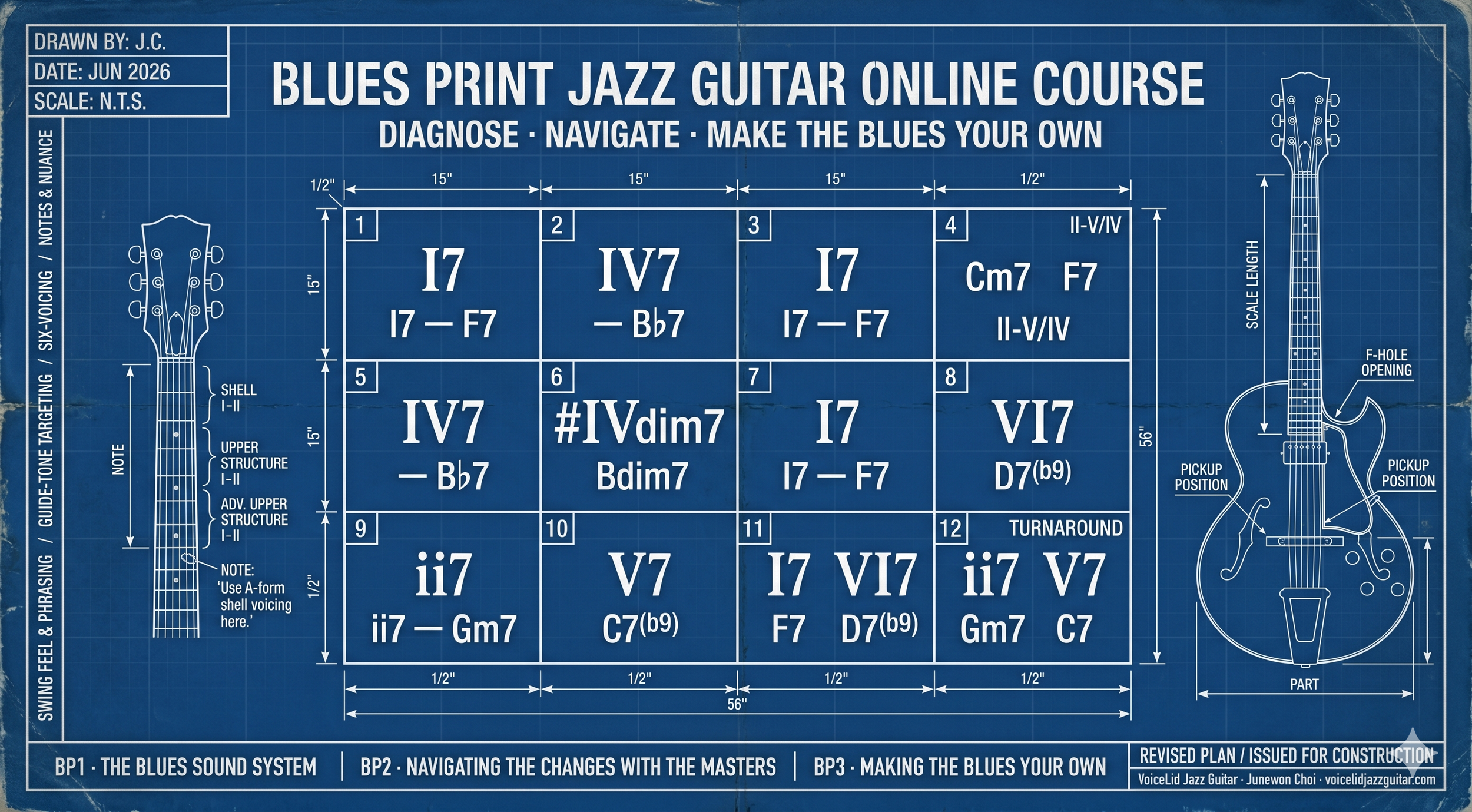
Blues Print is three courses, built in order — the same way you'd build from a real plan: cut the materials, lay the route through the changes, then make it your own. The pre-recorded videos solve the gaps every player shares; the 1:1 coaching in the bundle closes the ones that are uniquely yours.

Blues Print 1 — The Blues Sound System
Cuts the materials. Melody stays king: blue notes, blues nuance (approaching the major 3rd from the minor), major and minor blues sound, I vs. IV, and the six-voicing system (Shell 1·2, Upper Structure 1·2, Advanced Upper Structure 1·2).
Blues Print 2 — Navigating the Changes with the Masters
Lays the route. Take apart real blues solos by the masters: chromatic resolution of dominant function, guide-tone targeting, voice-leading skeleton lines, and how to keep a solo moving instead of repeating itself.
Blues Print 3 — Making the Blues Your Own
The finish. Swing feel vs. pop rhythm, accurate fingering and ghost notes, phrasing, and turning borrowed lines into your own voice. We dissect one of Junewon's own three-chorus blues solos, bar by bar.
Read from the masters' recordings — not copied from a book.
Blues Print 2 transcribes and analyzes these solos one at a time, against the original recording — not a backing track. You catch the fine differences in rhythm and nuance that a chart can never show you.
Sweet Alice Blues — George Benson
Cool Blues — Charlie Parker, played by Grant Green
Birk's Works — Dizzy Gillespie, played by Kenny Burrell (minor blues)
Things Ain't What They Used to Be — Duke Ellington, played by Jim Hall
Au Privave — Charlie Parker, played by Wes Montgomery
The centerpiece
James and Wes — Wes Montgomery. The F blues that minor blues sound resolves to major right at the end; that single contrast is the backbone of the whole curriculum. BP3 covers it from melody to solo.

A blueprint sits on a foundation. This one sits on Fundamental.
VLJG's Private Study is one language that stacks in order: Fundamental builds the structure of the jazz language, Blues Print puts that language to work soloing on the blues, then Rhythm Changes. Blues Print stands on its own — but the "something's missing" feeling, if you skip the foundation, is by design. I'll be straight with you about that.
Where the method comes from — Berklee's Wes Montgomery Lab
I learned the blues in Richie Hart's private lesson at Berklee. Every week I'd learn a melody and solo over my teacher's comping — but he wouldn't let me look at the fretboard. I had to find the voicings by ear, and my ears grew fast. Forfeit your muscle memory to your ear. This curriculum rebuilds that experience as pre-recorded video plus 1:1 coaching.

FAQs
Can I buy Blues Print on its own?
1
Yes. But it's designed to work on top of Fundamental's language structure, so on its own one foundational layer can feel missing. If you're serious about both, take the two bundles together.
What happens in the trial session?
2
30 minutes. Not a free lesson — a diagnosis session. We find which of the 13 sticking points is actually yours, confirm your best starting point — Blues Print, or Fundamental first — and decide whether this path is right. After the trial, you decide.
Why is there no price on this page?
3
Because the right entry point differs by player. Blues Print sits on Fundamental — some players start here, others need the foundation first. That’s decided in the trial, so pricing is discussed there.
I already own Fundamental. Do I still need a trial?
4
No second diagnosis needed — you’re already inside the system. Reply to any of my emails and I’ll open Blues Print enrollment for you directly.
Is there an expiry on the coaching sessions and reviews?
5
Yes. All sessions and performance reviews must be used within 12 months of purchase.
The blueprint is drawn. Start building.
6
Enrollment opens after a 30-minute trial session.
Serious inquiry only — enrollment opens after a required 30-minute trial session.