
Routine Building
Track A
Bridge Series
Stop collecting lessons.
Start building a Daily routine that turns theory into real playing.
Bridge: Theory
to understand fretboard
Build the structure behind what you play.
Go beyond shapes and see the system.
Connect scales, triads, and voicings into one functional map of the fretboard.
This is where theory stops being abstract — and becomes usable.
All three Bridge: Theory courses — Scale, Shell + Drop 2, and Triad. The complete harmonic vocabulary of the FDA system. Includes 60 days of full access to The FDA Routine app — all 12 keys, the modes and every string set.
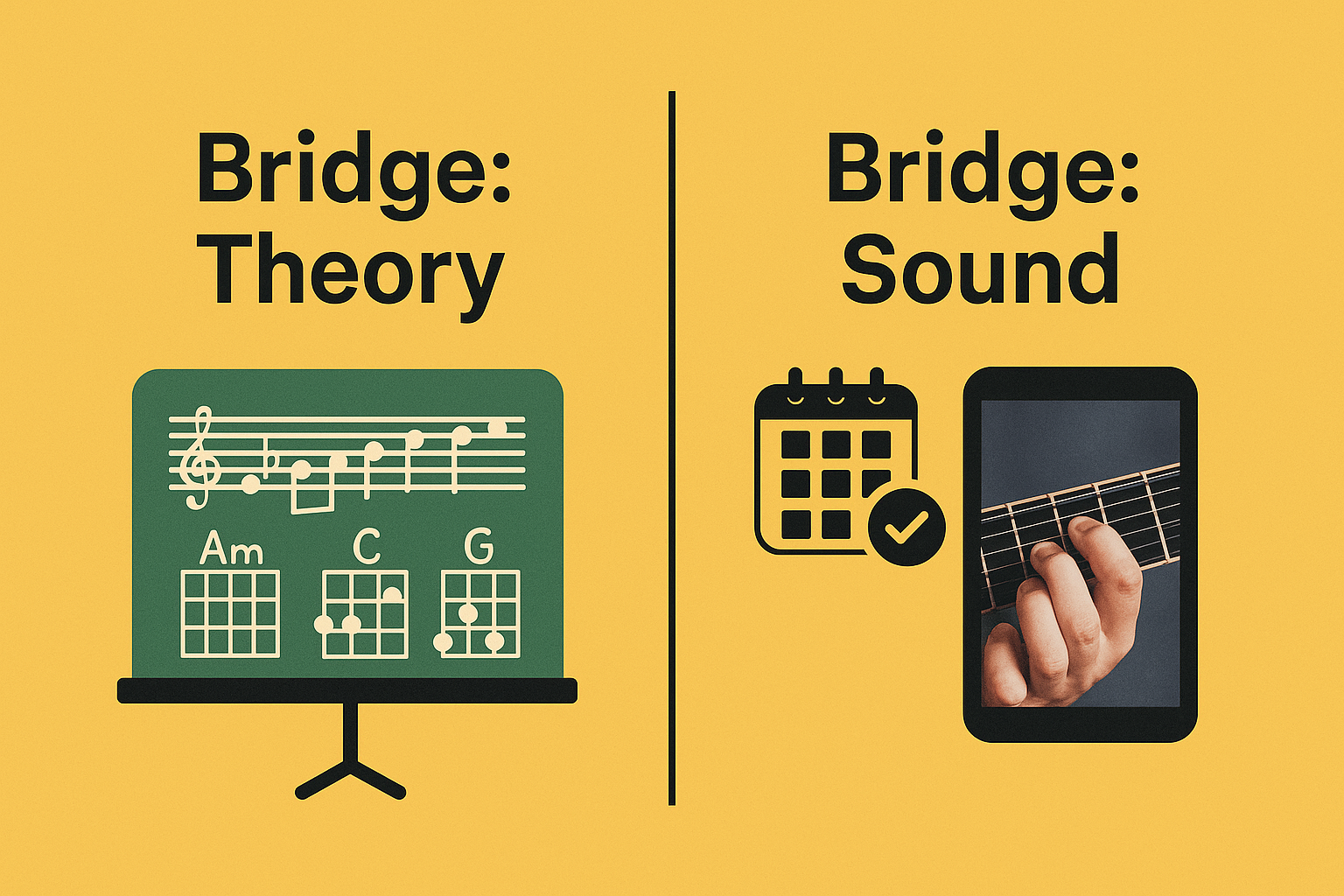
Bridge: Sound
Monthly Program - Structured Learning
Step-by-step curriculum for consistent growth.
Access in-depth video lessons, guided practice plans, and Theory classes designed to build real understanding—not just more patterns. Learn smarter, stay motivated, and keep improving every month.
Get anytime access to our growing collection of classes, workshops, and exclusive content. New items added every month.
As a member, you gain access to a wealth of resources and exclusive content tailored to your interests.
Get anytime access to our growing collection of classes, workshops, and exclusive content. New items added every month.
Both
Bridge: Theory
and
Bridge: Sound
share the same foundation
Three interconnected pillars of harmony: Scales & Modes, Shell + Drop 2Voicings, and Triads.
Theory helps you understand how they work; Sound helps you hear and feel them.
Together, they form one continuous bridge between knowledge and expression.
-
• Bridge: Theory:
Understand how scales create harmonic direction and modal color.
Learn to see the fretboard diagonally — function, not just position.
• Bridge: Sound:
Train your ear to recognize modal function through melodic exercises in all 12 keys.
Practice diagonal motion until the fretboard feels unified.
💡 Theory gives you direction. Sound gives you instinct.
-
• Bridge: Theory:
Explore vertical harmony — how upper structures define tonal hierarchy.
Learn to voice chords efficiently across the neck.
• Bridge: Sound:
Internalize comping movement through ear-led repetition and chord-tone voice-leading drills.
Focus on hearing how upper notes move, not just playing shapes.
💡 Theory builds structure. Sound gives it motion.
-
• Bridge: Theory:
Discover how triads create linear voice movement between chords.
Learn the logic behind harmonic flow — II–V–I, diminished passing, and substitutions.
• Bridge: Sound:
Apply triad voice-leading through 10-minute horizontal motion routines.
Practice connecting chord tones by ear, so lines emerge naturally.
💡 Theory connects harmony. Sound connects your hands and ears.